Most of the following are things that I started to do in 2013.
Economics Notes. As I complete my economics courses, I plan on blogging about what I learned in the process. So be prepared to see things about economic philosophy, the Federal Reserve system, the Great Depression, and free-market economics current application to U.S. politics. Because I discontinued my weekly health care posts in late 2012 (see below), I will occasionally, if not frequently, write about solutions to U.S. health care. Similarly, I will also write about the environmental policy occasionally.
Book reviews are in the works as well (see Theology notes section for style).
Theology Notes. I'm not taking any classes, but I do read theology and Christian apologetics books from time to time. And of course, there's always my weekly bible study. I plan on writing reflections on theology and book reviews of theology books. I plan to emulate book reviewers from various sources including Books and Culture, The New Yorker, and The American Spectator, but primarily the first two.
Miscellaneous Notes. I need some freedom to cover a large range of topics; so to serve that need I will be creating this section. This may cover poetry (I've been reading lots of poetry books), literature (novels, short stories), nutrition, pop culture, Christian culture, philosophy, and journalism, but I really am not sure.
Discontinued in 2013
Last year, I discontinued my "Weekly Health Review," a weekly wrap-up of important health care related news. However, I made it to Vol. 14 before doing so. Overall, those posts were pretty popular features of this site. Looking at the posts' view counts, they ranged from 18-70+ views each, but they mainly were between the 30-40 view range.
Monday, December 30, 2013


Sunday, December 29, 2013
Ancient Evidence for Belief in the Rapture (Or something rapture-like)
This hits home.
Francis Gumerlock, author of "The Early Church and the End of the World," has written an article in Bibliotheca Sacra that shows that there were "rapture" beliefs before the 1800s. As the common misconception goes, the rapture, which I do* believe in myself, was an invention of the 1800s.
A preview of that article is available here on his website. The title of the paper is Rapture in the Apocalypse of Elijah.
I first came along a similar notion when I first began reading Pagan Christianity in 2008.
From what I've read, the book doesn't actually come out and says the rapture was created in the 1800s (However, Gumerlock's paper cites a work that might. See the first footnote.). It doesn't even use the term rapture. However, it does talk about "pretribulational dispensationalism" which is linked to rapture beliefs.
From page 71:
Webster's New World College Dictionary, Fourth Edition defines spawned as, among other definitions, "to bring forth or be the source of (esp. something regarded with contempt and produced in great numbers)." So you could see how as a college sophomore (I finished my sophomore year I think and I was in South Carolina for the summer. Did that make me a "rising junior?) I could get a little confused about the origins of the rapture.
While my current church teaches the "rapture," it is one of the many things I disagree with at the church. And on Gumerlock's paper, I must add that he is not saying that belief in the rapture was widespread among early Christians. In fact, from the intro it only seems like a handful (to be generous), held that belief.
Read the intro here.
*Before correction, this post said that I don't believe in the rapture. That is wrong. I do.
Francis Gumerlock, author of "The Early Church and the End of the World," has written an article in Bibliotheca Sacra that shows that there were "rapture" beliefs before the 1800s. As the common misconception goes, the rapture, which I do* believe in myself, was an invention of the 1800s.
A preview of that article is available here on his website. The title of the paper is Rapture in the Apocalypse of Elijah.
I first came along a similar notion when I first began reading Pagan Christianity in 2008.
From what I've read, the book doesn't actually come out and says the rapture was created in the 1800s (However, Gumerlock's paper cites a work that might. See the first footnote.). It doesn't even use the term rapture. However, it does talk about "pretribulational dispensationalism" which is linked to rapture beliefs.
From page 71:
It is also worth noting that Moody was heavily influenced by the Plymouth Brethren teaching on the end times. This was the teaching that Christ may return at any second before the great Tribulation. (This teaching is also called "pretribulational dispensationalism.")In the footnotes on page 71, there is some unhelpful wording:
142. John Nelson Darby spawned this teaching. The origin of Darby's pretribulational doctrine is fascinating. See Dave MacPherson, The Incredible Cover-Up (Medford, OR: Omega Publications, 1975).
Webster's New World College Dictionary, Fourth Edition defines spawned as, among other definitions, "to bring forth or be the source of (esp. something regarded with contempt and produced in great numbers)." So you could see how as a college sophomore (I finished my sophomore year I think and I was in South Carolina for the summer. Did that make me a "rising junior?) I could get a little confused about the origins of the rapture.
While my current church teaches the "rapture," it is one of the many things I disagree with at the church. And on Gumerlock's paper, I must add that he is not saying that belief in the rapture was widespread among early Christians. In fact, from the intro it only seems like a handful (to be generous), held that belief.
Read the intro here.
*Before correction, this post said that I don't believe in the rapture. That is wrong. I do.
Monday, December 9, 2013
Bill Provine says evolution means no gods, no purpose, no life after death, etc
‘Let me summarize my views on what modern evolutionary biology tells us loud and clear … There are no gods, no purposes, no goal-directed forces of any kind. There is no life after death. When I die, I am absolutely certain that I am going to be dead. That’s the end for me. There is no ultimate foundation for ethics, no ultimate meaning to life, and no free will for humans, either.’ ~William Provine, 1994
While I somehow ran across this quote today from Creation.com (and I really don't know how I got to Creation.com, since I visit it only a few times a year, meaning 0-3; maybe I clicked on a link on a Youtube video I watched today), I actually heard Provine say this quote in his debate with Phillip E. Johnson many years ago. That's the only reason I'm quoting it; because it has sentimental value. It is otherwise pretty pedestrian, even if it is revealing.
I watched that video back as an undergraduate; it is below.
But on the free will thing, agnostic physicist Michio Kaku would disagree.
Saturday, November 23, 2013
The Books I Used To Write the Second-Longest Paper I Ever Wrote

When I was a senior in college, I wrote the second-longest essay of my life -- and it wasn't for a class. It was for a cash prize of $5,000.
In December 2009, I heard about the Atlas Sound Money Project Essay and, broke as the economy, I jumped for the cash prize. I did not win the first prize. A kid from Dartmouth did, if my memory serves me correctly. I also did not win the one of the two second prizes ($1,000), or one of the three third prizes ($500).
I had to choose between the following topics:
I choose the last one.Essay Topics:- “Money and the Free Society: Can Money Exist Outside of the State?”
- “The Ethical Implications of Monetary Manipulation”
- “Monetary Policy and the Rule of Law in the United States”
But cleaning up my desk this evening (how it surfaced to my desk 4 years later, I have no idea), I decided to discard the paper I had notes on and preserve the memory through this blog post.
Here are the books I used to write the 20-page essay, which was supposed to be "accessible to the educated laymen, but rigorous enough as to be used in college and university courses." That had my writing style written all over it.
These aren't the only sources I used. I also completed Robert P. Murphy's "Politically Incorrect Guide to Capitalism," some excerpts from some newsletters I was receiving at the time, and more. Besides the Murphy book, only other books I read in their entirety for this essay was "The Alpha Strategy" (which I have offered free of charge since November 2009), "Gold Wars," "Honest Money." I skimmed through the Sowell Book. I probably didn't cite the Faustino Ballve book nor the How the Fed Works book.Economics Reading List for Sound Money Essay-The Alpha Strategy-How the Fed Works (50 pages)-Essentials of Economics-Gold Wars-Honest Money (Esp. Biblical Monetary System)-Housing Boom and Bust
I also have some handwritten notes on this paper, such as "banks are good - fractional reserve isn't," "sell back gold to the public," "FDIC out of commission," "FED = Insurance Agency," "prevent recessions," "prices of goods will fall," "gov = tax in gold," " = pay in gold," and "no government mandate for gold-only. Gold is standard, but other metals are usuable (sic)." Corresponding page numbers were in parentheses next to these notes.
The Atlas Foundation's original blog post announcing the competition was published on December 2, 2009. The deadline to submit the essay was January 15, 2010. You can read the blog description here.
I'll publish the essay on a later date.
Thursday, October 31, 2013
David Berlinksi on the Old Testament
I would suggest to any student entering college now, 2011, to do what I'm sure he hasn't done: go read the Old Testament. That should be your first challenge today. I always ask my students "Well, have you (ever) read the, have you read the Bible? Yea, Yea, I read the Bible, sure. But when I interrogate the student it turns up reading the Bible means they have a Bible on their book shelf. And I said, "have you opened it?""Yea, we've opened it," but opening it doesn't mean reading it.
The Old Testament is the greatest repository of human knowledge and wisdom in the history of civilization, any culture, any time, any place. And that really should be the first point of discussion because every attitude current today in the discussion from Richard Dawkins, to me, to Christopher Hitchens, to lonely pastors in the Bible Belt on Sunday morning ranting from a particular text is discussed in the Bible, and there's a characters in the Bible who expresses that point of view, there's sympathy expressed for that point of view, and there's reservations expressed by that sympathy. It's an enormously complex, rich dramatic piece of work. That's the first.David Berlinksi on Uncommon Knowledge
Tuesday, October 22, 2013
Think Obamacare, Think Trabant
The Obamacare rollout, with the dysfunctional "Healthcare.gov" as the star of the show, reminds me of another service a government tried to roll out in competition with the private sector: transportation.
Specifically, the 1975 Trabant.
No, I was not around back then and definitely not in Germany (nor have I been east of the Atlantic Ocean), but everything I've read about Obamacare reminds me of Communism's answer to the Volkswagen Beetle.
The car has been on numerous "all time worst lists." It was also created under a communist regime.
Like free healthcare in socialist countries, you couldn't outright buy a Trabant. You had to apply for one and get put on a wait list:
 Not all things related to the Trabant are bad. But neither are all things related to Obamacare. The bad, as always, outweighed the good. The Trabant has symbolic value. So will Obamacare.
As Wikipedia puts it, "the Trabant is often cited as an example of the disadvantages of centralized planning; on the other hand, it is also regarded with derisive affection as a symbol of the failed former East Germany and of the fall of communism (in former West Germany, as many East Germans streamed into West Berlin and West Germany in their Trabants after the opening of the Berlin Wall in 1989).
The open-source entry continues: "It was in production without any significant changes for nearly 30 years, with 3,096,099 Trabants produced in total."
Talk about a lack of innovation.
Here is what a Time writer wrote about the Trabant in Time's 50 Worst Cars of All Time feature:
Specifically, the 1975 Trabant.
No, I was not around back then and definitely not in Germany (nor have I been east of the Atlantic Ocean), but everything I've read about Obamacare reminds me of Communism's answer to the Volkswagen Beetle.
The car has been on numerous "all time worst lists." It was also created under a communist regime.
Like free healthcare in socialist countries, you couldn't outright buy a Trabant. You had to apply for one and get put on a wait list:
For all its shortcomings, the Trabant 601 became highly sought-after in Eastern Europe, and buying one (prospective owners did not order their new Trabant; they applied for it) involved joining a waiting list that could last up to 18 years.

As Wikipedia puts it, "the Trabant is often cited as an example of the disadvantages of centralized planning; on the other hand, it is also regarded with derisive affection as a symbol of the failed former East Germany and of the fall of communism (in former West Germany, as many East Germans streamed into West Berlin and West Germany in their Trabants after the opening of the Berlin Wall in 1989).
The open-source entry continues: "It was in production without any significant changes for nearly 30 years, with 3,096,099 Trabants produced in total."
Talk about a lack of innovation.
Here is what a Time writer wrote about the Trabant in Time's 50 Worst Cars of All Time feature:
This is the car that gave Communism a bad name. Powered by a two-stroke pollution generator that maxed out at an ear-splitting 18 hp, the Trabant was a hollow lie of a car constructed of recycled worthlessness (actually, the body was made of a fiberglass-like Duroplast, reinforced with recycled fibers like cotton and wood). A virtual antique when it was designed in the 1950s, the Trabant was East Germany's answer to the VW Beetle — a "people's car," as if the people didn't have enough to worry about. Trabants smoked like an Iraqi oil fire, when they ran at all, and often lacked even the most basic of amenities, like brake lights or turn signals. But history has been kind to the Trabi. Thousands of East Germans drove their Trabants over the border when the Wall fell, which made it a kind of automotive liberator. Once across the border, the none-too-sentimental Ostdeutschlanders immediately abandoned their cars. Ich bin Junk!
Sunday, October 20, 2013
Christopher Hitchens, my home boy, and I

"Do you have an extra copy?" I recall him asking.
I didn't. And in fact, I thought about leaving him a copy but there wasn't a Kinko's in sight on our way there.
If I remember correctly, I was the last person to have anything signed by Christopher Hitchens that night. It was getting late. Christopher had already signed tons of autographs. And I believe he had a plane to catch.
My homeboy, then a Christian, asked Christopher why he didn't believe in God?
It was one of those, "it's obvious there is a God, why don't you believe in him?"-type questions. It was very passionate.
I don't remember Christopher's response.
But my friend asked him the question as he was still sitting down. I had just stepped away after my paper was signed. Shortly after saying something, Christopher Hitchens stood up, and either he or his help had a gray wheeled luggage bag (or maybe I'm confusing his bag for the one Frank Turek possibly had). He told Christopher about his flight.
That one Christian guy who asks atheists why they don't believe
I was reminded of the entire 2009 TCNJ scene when an old white man, after the Q&A opened up, popped the first question to ask Richard Dawkins at the National Press Club a few weeks ago. Also admittedly an atheist -- at least for that night -- Sally Quinn, a long-time Washington Post reporter and editor, gave one of the worst interviews of Richard Dawkins I've ever seen.
Why do I say that?
Because she steered the conversation to make Richard Dawkins says things that he has literally said 1,000 times before in his speaking and debate circuits after the publication of his 2006 bestseller The God Delusion. We could Wiki some of his answers. This lady is a religion editor. You would have thought she would have done her homework. Maybe she did. Maybe she had done the kind of preparation for a test where the examiner doesn't question you on anything you had studied for. That would be apt, except she was the examiner. And examiner decided to test you on last month's material, which you certainly knew, but were prepared for something more recent (Does this hypothetical ever happen? lol)
Richard Dawkins was there on September 30, 2013 to discuss his new book "An Appetite for Wonder: The Making of a Scientist" (2013), the first half of his two-part memoir. The best she could have done was read excerpts from the book, and then ask him to expound on that.
"What did you mean when you said..." would have been a much more productive way of interviewing than pointing out he became an atheist in his teens (something he has said many times before) and contrasting that with her own awareness that she was an atheist at age 5. Instead, she barely asked about the book, in my view. As I see it, she was a Washington Post reporter getting an exclusive interview with Richard Dawkins and used her exclusive interview to self-servingly get some personal questions answered.
Anyway, after what I guess was a half-hour of virtually unproductive conversation, the Q&A started.
The aforementioned first questioner asked "Why don't you believe in the empirical evidence of the resurrection of Jesus Christ?"
The question brought me back to my friend who asked a similar question with the same underlying vein: "Dear atheist, why don't you see it?"
Thank you for saving me, Richard Dawkins
I respected the question. Both questions. But I must say the following time was spent on two non-questions, a question about when atheism is going to catch on (or something like that) and at least one conspiracy-deny conspiracy theorist. I'll get to the latter in a second.
But a woman explained that she was on the way to the nunnery when she picked up a copy of Richard Dawkins' classic The Selfish Gene, which was even required text for some classes at my alma mater of La Salle University. At that point, she had dropped everything, changed course of her life to one that was religious and would have been completely religious if she had become a nun, and embraced the secular life in all its wonder.
Another man, a former Muslim originally from a Middle Eastern country, explained that it was The Selfish Gene that was the text that changed his outlook on life.
Another guy, who apparently attempted to indulge in some camaraderie before posing his question by, I think, tipping his hat towards The Selfish Gene or maybe some other RD work, asked something to the effect of "What do you think about Government conspiracy?" I believe it dealt with the fact that governments lie. That is true. (I'm sure the question is on tape. That will correct the record.) But there was some brief mention of 9/11 conspiracy theories, but the way it was postulated it was like he was trying to have it both ways. Sure he was secular, maybe even thought of himself as a critical thinker, and whatever he researched in his personal time he may have indeed had some good points, but the way he asked his question was ambiguous, and one wouldn't know if he was pro-conspiracy theory or not (I, for one, think they're OK, if support by facts). Richard was puzzled. So was I.
It also reminds of the way Sally Quinn conducted her interview. Not that her questions had anything to do with conspiracy. They didn't. But I feel like she used the opportunity to ask questions so he could answer and, in effect, do the research for her.
And that's the same way I felt with the guy. Richard Dawkins, by all accounts, is a scientist, not a philosopher of religion, or a political philosopher. (He did mention he wanted to live in a world where people pay taxes, as if taxes were moral things in themselves. In that case, I wouldn't want to live a world that Richard Dawkins gets to construct.) So asking him a political question is kind of intellectually lazy on the questioners part, because it seems like all these people want them to do is give free advice or do the research for the person.
Can we finally--finally!--talk about the book?

In the end, I met Richard Dawkins for the first time. Saw a buddy -- who described himself as "not convinced" by Dawkins and somewhat of "a mystic" -- I recently met a few weeks ago there. And got two RD's signature. It was the only novel thing I got from the experience, and perhaps the only novel thing other attendees got from their experiences. It's not like they could get a novel interview when it's conducted by Sally Quinn. Not that day, at least.
I did entertain a few people waiting in line to get there book signed. And one guy, probably one of the only other black people in the crowd (whether Tea Party rallies or anti-war rallies, politically left or politically right, black people hardly are in the crowds where I do my serious reporting or blogging) recommended I buy Vincent Bugliosi's "The Divinity of Doubt: The God Question." It has been added to my Amazon Wish List.
I ordered The God Delusion a few days before, and so I didn't have the physical copy in front of him to sign. He signed my Amazon receipt instead, which I cut out and pasted into my copy of The God Delusion when it arrived in the mail days later.
The other thing I had RD sign was a printed page of the old Richard Dawkins website. There was a post on there about Richard Dawkins "fleas" (the number of response books to The God Delusion). The blue response book, picture above, is what I originally planned on posting that second RD signature into. I haven't done that yet. The Ipod Tutor: The Argument Against Richard Dawkin's The God Delusion is one of three response books I own. I also own secular Jew, agnostic, and mathematician David Berlinki's book "The Devil's Delusion: Atheism and it's Scientific Pretension's" and Christian and mathematician John Lennox's "God's Undertaker: Has Science Buried God?" I bought all three response books back in college prior to 2011. Perhaps all prior to 2010. I haven't completed one, although I did get through a good portion of Lennox's book back in college, with the highlights, and red and blue ink to show for it. I plan to read all four books soon, meaning within a year or two, starting with the Dawkin's book.
He (RD) was eminently pleasant, by the way.
"Do you want me to sign here?" he said. I was in awe and calmed by his pleasant demeanor.
Monday, October 14, 2013
Liberals: Gun Control leads to violation of other rights; Conservatives: The right to bear arms is violated with Stop-and-Frisk

Anthony Gregory of the Independent Institute explains:
Even today, gun laws are much like drug laws in that they are disproportionately used against minorities. Gun control is the chief impetus behind New York City’s Stop-and-Frisk program, which in 2011 ensnared young black men more times than there are young black men in the city, and targets minorities by a ratio of nine to one. Conservatives who defend this program are defending gun control at its most invasive—the wholesale profiling and searching of people in the attempt to procure guns, which conservatives claim people have a natural and constitutional right to carry in the first place. Liberals opposed to this program should recognize that to violate gun rights, government must violate other rights.
He also quotes a former Black Panther party leader on the matter:
Elaine Brown, head of the Black Panther Party in the 1970s, recently explained:On Reagan:
The position of the Black Panther Party was that black people live in communities occupied by police forces that are armed and dangerous and represent the frontline of forces keeping us oppressed. We did not promote guns, but rather, the right to defend ourselves against a state that was oppressing us — with guns. There were innumerable incidents in which police agents kicked in our doors or shot our brothers and sisters in what we called red-light trials, where the policeman was the judge, the jury and the executioner. We called for an immediate end to this brutality, and advocated for our right to self-defense.
As governor of California, Reagan signed the Mulford Act into law in 1967. Written by Republican Assemblyman Don Mulford, the legislation was the most sweeping state edict in all the country, prohibiting the more or less free carrying of firearms in public. It went along with the rest of his heavy-handed entire law-and-order agenda and inspired an avalanche of new gun laws nationwide.The purpose of the law was to disarm the Black Panthers, a radical leftist group that openly carried firearms, kept an eye out on the police, and even took their rifles to the state Capitol to protest what they decried as racist legislation. (bold edits are my own ~GR)The Tea Party and the Black Panthers have something in common. Strange bedfellows.
Schiff: Obama's wrong when he says we have to raise the debt ceiling because we have to pay our bills
President Obama has often repeated that not raising the debt ceiling is an acknowledgement that the United States (Government) can't pay its bills.
What's the contrary position?
What's the contrary position?
"When President Obama says that have to raise the debt ceiling, because America always pays its bills, he's wrong. The reason we have so much debt, is because we never pay our bills. And the reason that we have to raise the debt ceiling is because we can't pay the bills. So we want to borrow more money instead. If we leave the debt ceiling alone, then we finally actually have to deal with the bills. And the problem is, we borrowed so much money, it's impossible to pay it back. And that's what president Obama doesn't want our creditors figuring out." Peter Schiff on The Street (Video)
Are modern economists right that eliminating deficit spending will decrease GDP?
From a recent op-ed in Capitalism Magazine:
According to modern economists, an elimination of deficit spending will immediately cause a dollar for dollar decrease in GDP. For example, if the government stopped sending food stamp payments to poor people, then grocery stores would lose business, employees would be laid off, and the economy would contract. But this one dimensional view fails to appreciate that the purchasing power of the food stamps had to come from somewhere. The government can’t create something from nothing. Taxation transfers purchasing power from people living in the present to other people living in the present. In contrast, borrowing transfers purchasing power from people living in the future to people living in the present. The good news for politicians is that future people don’t vote in current elections (and current voters don’t seem to appreciate the cost to their future selves of current policy).
Sunday, October 13, 2013
Greed is not good

(Update at 8:28 PM: So I am still studying and ran across this scripture. Jesus himself is speaking: "And he said to them," Take care! Be on your guard against all kind of greed; for one's life does not consist in the abundance of possessions." Luke 11:15)
Greed is, quite simply, a sin, under the category of idolatry.
Of course, Wall Street businessmen and politicians aren't the only ones capable of being greedy, or impure, or having (sexual) passion (outside of the will of God), or evil desires. The large part of society who are non-politicians have the same capacity.
And "on account of these the wrath of God is coming on those who are disobedient."
The upside to all of this in the next verse.
"These are the ways you also once followed, when you were living that life."
Through Jesus, who is also called Y'shua or Yeshua, through his death on the cross and the power of his resurrection, we are able to be forgiven for our sin and are enabled by the Holy Spirit (the Ruach Hakodesh) to live holy lives. Formerly greedy people, formerly sexually passionate people, and so forth, who once lived those lives are capable of living new ones.
May the Gospel of Jesus Christ flourish in the hearts of men...
...including the Wall Street crowd and the political class.
Subscribe to:
Posts (Atom)
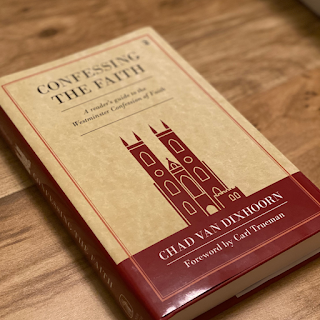
WCF Chapter One "Of Holy Scripture" Sunday School (Sept.-Oct. 2021)
Our text for Sunday School (also "The Confession of Faith and Catechisms") Biblical Theology Bites What is "Biblical Theology...
-
January 12, 2012 Update: The old link no longer works. The old link is still below but the new leak is right below the old link. Thanks to t...
-
 Our text for Sunday School (also "The Confession of Faith and Catechisms") Biblical Theology Bites What is "Biblical Theology...
