Showing posts with label Resurrection. Show all posts

Monday, September 28, 2015

Video: Rosaria Butterfield on Her Conversion from Lesbianism


Rosaria Butterfield used to live a lesbian lifestyle.

Now, I will spare those who are curious as to whether that means she was in the "gay-as-long-as-I-can-remember" camp. She was not. She got into it pretty late.

But all this means is that she connects with the thousands or millions of people who have embraced homosexual lifestyles post-high school or post-college.

Nevertheless, she is clear, insightful and has a heart for those in the LGBT community.

For one, she, like myself, is against reparative therapy.

In an essay, she puts it this way:
"This position contends a primary goal of Christianity is to resolve homosexuality through heterosexuality, thus failing to see that repentance and victory over sin are God's gifts and failing to remember that sons and daughters of the King can be full members of Christ's body and still struggle with sexual temptation. This heresy is a modern version of the prosperity gospel. Name it. Claim it. Pray the gay away."
She is right, and she is taking the biblical view.

My reason for rejecting reparative therapy comes straight from the Bible as well.
Or do you not know that wrongdoers will not inherit the kingdom of God? Do not be deceived: Neither the sexually immoral nor idolaters nor adulterers nor men who have sex with men nor thieves nor the greedy nor drunkards nor slanderers nor swindlers will inherit the kingdom of God. 
And that is what some of you were. But you were washed, you were sanctified, you were justified in the name of the Lord Jesus Christ and by the Spirit of our God. (1 Corinthians 6:10-11 NIV)
Almost 2,000 years ago, people were, before the arrival of modern technology, dealing with homosexual attraction and having homosexual intercourse. And, by the grace and Spirit of our God, they were washed and sanctified from their sins -- sex-related or not. Notice the inclusion of all kinds of sins in the passage.

No doctors, except the Great Physician, were present.

No medical contraptions, no weird methods or instruments designed to make a gay person straight were used.

It's also worthy pointing out what comes next:
The body, however, is not meant for sexual immorality but for the Lord, and the Lord for the body. By his power God raised the Lord from the dead, and he will raise us also. Do you not know that your bodies are members of Christ himself? (1 Corinthians 6:13-15 NIV)
God's power, the same power that lifted the Lord Jesus from the grave, will lift us also in the Resurrection.

She also makes book recommendations. I trust them.

One of them is Christopher Yuan's Out of a Far Country.

Wesley Hill's Washed and Waiting is another book she recommends. Wesley Hill was one of those gay people who at around age 5 or 6 knew they were different.

She also mentions The Art of Neighboring as a book she is currently working through.

While she doesn't recommend it, Kevin DeYoung's "What Does the Bible Really Teach About Homosexuality?" has been recommended by a lot of people.

The Q&A is as good as the presentation, if not better. Watch the entire thing. It's worth it.

Tuesday, March 24, 2015

Video: 5 Minute Sermons - A Transformed Life


I wanted to hear something quick but biblical before I started my work last Friday so I googled "5 minute sermons." This is the first thing that popped up on the Google Search -- and I must say that it is very good!

Tuesday, April 22, 2014

A not-so-hard question to answer from one atheist blogger

At Patheos, James Croft wrote some years back, recalling a live lecture (2012) on miracles from Ph.D. mathematician and Christian apologist John Lennox:

The Q&A was brief, but I’m glad my question was chosen to be asked: “ If I was to tell you I were just raised from the dead, what evidence would you require to believe it?”
I ask this question of all apologists for Christianity, because it goes right to the heart of the evidentiary claim: what would it take to convince them that someone they encountered today had indeed risen from the dead? There are two common responses: either apologists evade the question, or answer with standards of evidence way higher than the standards of evidence they use when considering the resurrection of Christ.
Apparently, if you go to read on, Dr. Lennox had trouble answering this question.  So I'll take this one.
Prove you were dead.
What could they possibly say in response?
Perhaps around before the publication of atheist philosopher Peter Boghossian's book "A Manual For Creating Atheists," and certainly codified in it, is the notion that Christians will evaluate a piece of evidence against Christianity very critically, so much more than they would examine any other piece of evidence for the veracity of their faith.
In their experience, Christians have had abominably lopsided approaches to evaluating evidence ("A false balance is an abomination to the Lord" Proverbs 11:1; "Do not use dishonest standards when measuring length, strength, or quantity" Lev. 19:35; "Do not have differing weights in your bag--one heavy, one light" Deut. 25:13).
This is, apparently, a common sticking point that atheists have in conversations with Christians, and is fashionable to regurgitate in talks online discussing the alleged implausibility of the Christian faith.
And if John Lennox couldn't answer this simple question, as was reported in the rest of the post that I didn't quote, I submit he was thinking too hard, and sticking too closely to his talking points. And if other Christians haven't been able to answer this question, I submit Christians need a lot more training in critical thinking. 
Putting the onus of proof on himself
So again, prove you were dead. 
His question puts all of the weight on the resurrection part. But his question hasn't even got off the ground yet, and may not ever.
He forgot somebody actually had to die to get there first. And apparently, he forgot he'd also had to prove that his lifeless corpse would have had to have to undergo a certain scientific examination itself -- and then be pronounced dead by the authorities. His metaphorical "tomb" would have to been made known to some folk, which was exactly was known of Jesus's tomb, before he met back up with his disciples to talk about the resurrection that just happened.
I mean, it's a common Christian retort that is beyond cliche territory, but, I mean, you know, he wouldn't want us to take the premise of his question on faith now would he?
And for all of his appeal to our modern sensibilities, you would have at least thought he would have been kind enough to provide his I.D. and death certificate so we could verify. There was no mention of those credentials in his blog.
In the gospel of John, we have a real doubting Thomas who asks a similar question. 
“Unless I see the mark of the nails in his hands, and put my finger in the mark of the nails and my hand in his side, I will not believe.” A week later his disciples were again in the house, and Thomas was with them. Although the doors were shut, Jesus came and stood among them and said, “Peace be with you.” Then he said to Thomas, “Put your finger here and see my hands. Reach out your hand and put it in my side. Do not doubt but believe.” Thomas answered him, “My Lord and my God!” Jesus said to him, “Have you believed because you have seen me? Blessed are those who have not seen and yet have come to believe.” (John 20:25-29 NRSV)
Thomas asked. Thomas received. And this is of course recalled in one of four death certificates, I mean gospels, of Jesus' life. These are the death certificates we show non-believers all the time, and the I.D. where we can read about the life of our Lord, but with much more detail than a 2.5 x 4 I.D card.
Part of the problem with presumptuous, sloppy, and snobbish questions is that they assume too much and prove too little, if anything.
And that is where he went wrong. At least, if you believe in the historical Jesus you would believe that he died by crucifixion and was buried in the tomb of Joseph of Arimathea. Unless, of course, you are one of those types that believes he died and was buried in a shallow pit to be eaten by dogs (bad), or you don't believe in Jesus existed at all (worst). 
Christians have a testimony grounded in history, four separate documents from four separate authors that attest to Jesus' crucifixion, on top of multiple ancient authors to attest to his crucifixion and burial.
This guy has a question backed with the conceit of a college sophomore.
The Close of the Atheist Witness
Reframing the question, if done in a way that oversimplifies the question, looses a few key premises, and then answers a straw man, is definitely unfair, and an abomination unto the Lord, and violates doing unto others as we would have done unto us.
But I do believe the blogger asked a question that needs some work [1]. I do think the question misunderstands some things about resurrections. I know a person who was legally dead (heart stopped) and then was resuscitated by doctors, which is what many of the "resurrections" in the New Testament are like. They are brought back to life to die again. But Jesus is the "first fruits," that is, the first of the resurrection unto immortality. And by definition, this 21st century man claiming to be resurrected can't be. The dead will be raised; flesh will put on immortality; corruption will put on incorruption (1 Corinthians 15:52-54), and all of this will happen at the "Last Trump" (v.52), not right before a Q&A at a John Lennox lecture.
For as in Adam all die, so also in Christ all will be made alive. But each in his own order: Christ the first fruits, after that (Who?) those who are Christ's at (When?) His coming, then comes the end, when He hands over the kingdom to the God and Father, when He has abolished all rule and all authority and power.… (1 Corinthians 5:22-24) [emphasis mine]
Apart from scripture and revelation, which, if true, is intimately linked to past, present, and future history, his question doesn't make any sense. Indeed, his claim to have been resurrected would mean that God is a liar that didn't keep his promise to raise the saints of God on the "Last Day." And that, personally, would raise my eyebrows indeed and warrant my scrutiny.
Indeed, his question can't even make sense in a world where atheism is true because by definition there would be no God to raise him.
On the apologetic method, I didn't even have to worry about who raised you or when were you raised or even begin to answer the question. I just made a simple demand: just prove you were dead. And then after that, prove your theology.
Like the question "Who Made God?" this question, like the former, as John Lennox put that one, is in schoolboy category, because, like how atheists misunderstand the nature of God, this question fundamentally misunderstands the nature of the resurrection.
And according to scripture, I would simply be able to look at him in his glorified body to see if he was resurrected. So would Lennox.
  1. I do think if he reduced his question to the point of simple "miracles" he would have a stronger case. But choosing the specific term "resurrection" he did not. For example, if he reframed it as "If I was to tell you that God performed a miracle in my life, what evidence would you require to believe it?"

Monday, March 31, 2014

Why the rapture scenario you've been taught is wrong

[Editor's Note: I unpublished this a few days ago because I wanted to work more on the N.T. Wright part. I am now republishing it without the changes. I do, however, want to work on the N.T. part more but I'd rather re-edit this post at a future date or post an entirely new post in the future. ~The Editor, 4/22/14]
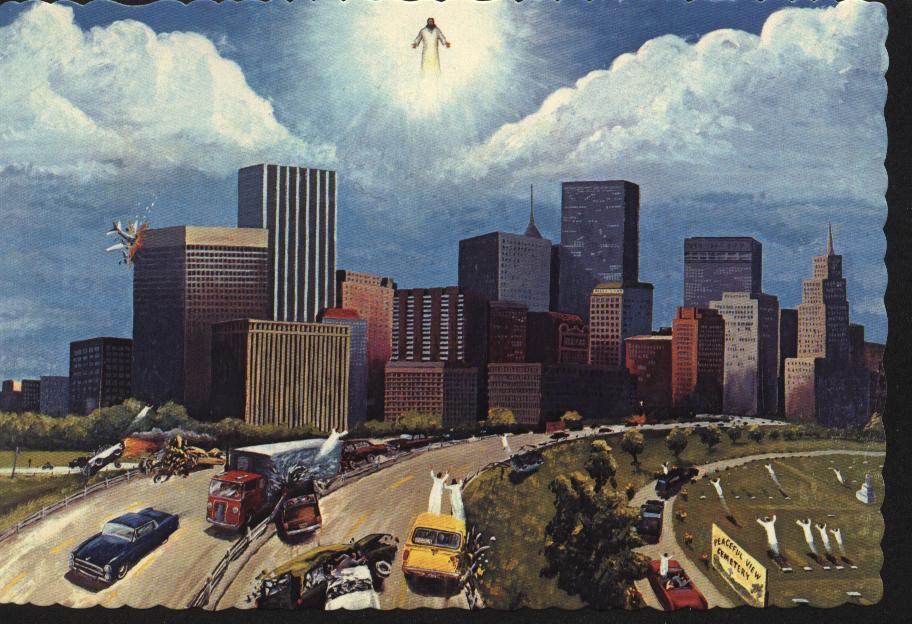
The American obsession with the second coming of Jesus — especially with distorted interpretations of it — continues unabated.  Seen from my side of the Atlantic, the phenomenal success of the Left Behind books appears puzzling, even bizarre.  Few in the U.K. hold the belief on which the popular series of novels is based: that there will be a literal “rapture” in which believers will be snatched up to heaven, leaving empty cars crashing on freeways and kids coming home from school only to find that their parents have been taken to be with Jesus while they have been “left behind.”  This pseudo-theological version of Home Alone has reportedly frightened many children into some kind of (distorted) faith. N.T. Wright, "Farewell to the Rapture" (2001)
I made a mistake in a previous blog post. I do believe in the rapture. I just don't believe in the rapture as generally preached by many dispensationalist pastors, including my own pastor. Yes, I attend a church where I question the theology quite a bit. And I've spoken to people outside the church about this matter; and surprisingly, they've asked "do you think this is the place God has placed you?"  I think the answer is a resounding yes. In short, I think I've been placed there to change things a little bit.

But I recently had a conversation with a young believer a few nights ago and that conversation eventually turned to the rapture.

We spoke about my long-held desire that some celebrities give their life over to the Lord Jesus Christ. But this person then said that Satan once controlled the music in heaven, and therefore strongly influences the music culture today.  The former is belief, by the way, that is held on popular Christian websites such as this one.  She pretty much then expressed that the satanic influence over their lives is so powerful that they won't even have the possibility to repent and be saved until after the rapture.

Once they see that, once they get the seriousness of God, and the evidence of him, then they will turn and repent. After the rapture, she explained, "it will be hell on earth." She then pointed me to the book of Revelation.

It reminded me of talking to one of my homeboys (the same homeboy in this post) back in the day when I criticized the rapture then. Why would God rapture all the Christians away and leave all the unbelievers to perish in a "hell on earth" for years on end? Why wasn't anyone left behind to preach to them? And a new question to my friend, where is their rapture? Wouldn't Jesus need to make a third and fourth coming? Would Paul and Jesus preached about a resurrection for the righteous and wicked and then another resurrection for the repentant? My questions are ultimately inconsequential to God's will. God's ways are not my ways. I recognize that. But these seem to be legitimate questions.

And then, she did it. She mentioned the Left Behind Series. No, I did not see it, I replied. Nor have I read the books. But in 2010 I did catch the Catholic Defamation League's review of it. The author of that 2004 post had this wonderful thing to say:
The Left Behind books and their non-fiction companions are filled with poor writing, bad theology, and anti-Catholic bigotry. It’s best to leave them behind and rely on Scripture, Tradition, and the Magisterium of the Church when studying the end times—or anything else.
Oh yea, I also played the awful video game too.


But all of this haphazard interpretation of scripture that concerns me. My view of the rapture is, I'd like to believe, the scriptural one.  Generally speaking, I am in the late Greg L. Bahnsen's camp on this one. But I also took a peek at N.T. Wright camp grounds, too. I'm using binoculars to scout it out, so I'm keeping my distance.

Bahnsen taught that the rapture, the resurrection of the saints and the wicked, all pretty much happen on the Last Day.

Here's the conclusion (but you're going to want to read how he arrived at that conclusion):
We must conclude from God’s word that the rapture will not eventuate prior to the very last day of history, that it will not leave behind the world of the wicked, and that it will not separated from the resurrection and judgment of the wicked.  The pre-tribulational rapture seven (or three and a half) years before the Lord’s return is contrary to the teaching of the bible.  Furthermore, it must be noted that the rapture of the saints will be anything but a secret event; it will be accompanied with the shout of Christ, the voice of the archangel, and the trump of God (I Thess. 4:16-17).  Nobody will miss it.
Read the rest of Greg L. Bahnsen's "Rapture and Resurrection" (1975) here.

N.T. Wright is a little bit less clear (not a surprise) and disagreeable but helpful. He does say the following up front, which lets us know he still believes in the essential stuff: "The Ascension of Jesus and the Second Coming are nevertheless vital Christian doctrines, and I don’t deny that I believe some future event will result in the personal presence of Jesus within God’s new creation." In this article, he doesn't mention the Last Day, and seems to downplay being caught up in the air. 

Next up, the troubling stuff.

Troubling passage #1:
Paul’s mixed metaphors of trumpets blowing and the living being snatched into heaven to meet the Lord are not to be understood as literal truth, as the Left Behind series suggests, but as a vivid and biblically allusive description of the great transformation of the present world of which he speaks elsewhere. (emphasis mine)
I agree with this on some level, because Matthew 24 borrows heavily from various Old Testament Prophets.  And "coming" really refers to a judgment in those instances. It's not a literal "coming" like you are coming back to town in your 2-door coupe.

N.T. Wright's article "Farewell to the Rapture" should be read immediately after Bahnsen's. He provides an in-depth look at the Old Testament imagery Paul is borrowing as well as some imagery from the first century. Here's a pertinent passage:
Third, Paul conjures up images of an emperor visiting a colony or province.  The citizens go out to meet him in open country and then escort him into the city. Paul’s image of the people “meeting the Lord in the air” should be read with the assumption that the people will immediately turn around and lead the Lord back to the newly remade world. (Emphasis in italics mine)
I sorely want to agree with this, especially with the leading the Lord "back to the newly remade world" part.  But where in this passage does Paul conjure up this imagery? I think the strongest thing Wright did to cast doubt on the dispensationalist position was in the leading paragraph in his article (and this article) that I quote above.

Bahnsen, writing nearly 30 years before Wright, wins on clarity. Wright simply raises more questions. I think Bahnsen does more to refute the dispensationalist rapture position. Wright doesn't puncture the skin.

Read the rest of N.T. Wright's "Farewell to the Rapture" (2001) article here.

Monday, June 3, 2013

Antony Flew: Libertarian

Many Christians know of Antony Flew because he was an atheist and debated Christian apologist William Lane Craig and resurrection scholar Gary Habermas. But Flew was also a friend of liberty and an advocate for political and economic freedom.

Here are some of his writings in "The Freeman," a publication of the Foundation for Economic Education.

WCF Chapter One "Of Holy Scripture" Sunday School (Sept.-Oct. 2021)

Our text for Sunday School (also "The Confession of Faith and Catechisms") Biblical Theology Bites What is "Biblical Theology...