Saturday, July 18, 2015

Bill Bonner on the Establishment's Willful Ignorance

Taken from page 30 of his book "Hormegeddon":

"The trouble with The Economist, The Financial Times, the US Congress and most mainstream economists is not that they don’t know what is going on, but that they don’t want to know. It would be counterproductive. Nobody gets elected by promising to do nothing. Nobody gets a Nobel Prize for letting the chips fall where they may. Nobody attracts readers or speaking fees by telling the world there is nothing that can be done. Instead, they meddle. They plan. They tinker. Usually, the economy is robust enough to thrive despite their efforts. But not always." 

Tuesday, July 14, 2015

H.L. Mencken on True Patriotism

"The notion that a radical is one who hates his country is naïve and usually idiotic. He is, more likely, one who likes his country more than the rest of us, and is thus more disturbed than the rest of us when he sees it debauched. He is not a bad citizen turning to crime; he is a good citizen driven to despair." - H. L. Mencken

Saturday, July 4, 2015

Yvette Carnell: Were drones flying while Obama eulogized in Charleston?

"Even as Obama gathered with mourners today, there is probably a drone buzzing above the heads of brown people in some Middle Eastern country, as they too, like the nine lost in Charleston, wonder what they did to deserve their fate." ~Yvette Carnell

Friday, July 3, 2015

How Should Christians React to the Supreme Court's Decision on Same-Sex Marriage?

Douglas Wilson explains here.  Here is an excerpt:
But in the meantime, we must use these enclaves, for however long they last, as places to gather, worship God, regroup, educate our children, marshal our resources, and counterattack.
How do we counterattack? By preaching the Word. These people cannot understand words because they will not worship God the Father through His Word. Given the nature of man, and the nature of the gospel given to save the natural man, none of this should come as a surprise to us. So what do we do? We preach the Word, whether or not anyone wants to hear it.
“Preach the word; be instant in season, out of season; reprove, rebuke, exhort with all longsuffering and doctrine. For the time will come when they will not endure sound doctrine; but after their own lusts shall they heap to themselves teachers, having itching ears; And they shall turn away their ears from the truth, and shall be turned unto fables” (2 Tim. 4:2–4).
Taking all in all, this is a glorious time to be alive. Faithfulness to Jesus Christ is becoming more obviously meaningful by the day."
There is much more. If you are wondering why there is a picture of the Queen from Alice in Wonderland, then you have to read why Wilson says the character is relevant to figure out why I posted it.

Read the rest here.

Video: Real T@lk - Connected Pt. 3 | All Def Poetry x Da Poetry Lounge

Thursday, July 2, 2015

Audio: The Demise of Guys in a Tough Economy - Games and Pornography

This is episode is very helpful in many ways. Despite the title focusing on Games and Pornography, the show focuses on a lot more than that. This is the "Demise of Guys" website.

Check out the radio show below.

Click here to play it from the Sermon Audio website.

Description from the web:
Pornography is way more accessible today than it was 100 years ago. There were hardly any sports, let alone computer games, in the average boy’s life 100 years ago. Now computer games are everywhere.
The character of guys is failing, but the economy is only getting tougher. So what gives? Kevin Swanson discusses with Joshua Christiansen (from Proverbs66.com) regarding the critical importance of faith and character in the lives of our young men (and young women).

Tuesday, June 30, 2015

T.S. Eliot Chrestomathy: On Poetry and Poets Edition

T.S. Eliot's On Poetry and Poets is turning out to be a very insightful book. I put together a list of really insightful passages from the first chapter, "The Social Function of Poetry,"  for your edification.


T.S. Eliot on the decline of religious sensibility

"Much has been said everywhere about the decline of religious belief; not so much notice has been taken of the decline of religious sensibility. The trouble of the modern age is not merely the inability to believe certain things about God and man which our forefathers believed, but the inability to feel towards God and man as they did."

"The Social Function of Poetry" in On Poetry and Poets by T.S. Eliot

I can relate to what T.S. Eliot said about foreign languages

"But I have also found sometimes that a piece of poetry, which I could not translate, containing many words unfamiliar to me, and sentences which I could not construe, conveyed something immediate and vivid, which was unique, different from anything in English -- something which I could not put into words and yet felt that I understood. And on learning that language I found that this impression was not an illusion, not something which I had imagined to be in the poetry, but something that was really there.  So in poetry you can, now and then, penetrate into another country, so to speak, before your passport has been issued or your ticket taken."

"The Social Function of Poetry" in On Poetry and Poets by T.S. Eliot

T.S. Eliot on the Greatest Poets' Influence of Language

"A poet like Shakespeare has influenced the English language very deeply, not only by his influence on his immediate successors. For the greatest poets have aspects which do not come to light at once; and by exercising a direct influence on other poets centuries later, they continue to affect the living language. Indeed, if an English poet is to learn how to use words in our time, he must devote close study to those who have used them best in their time; to those who, in their own day, have made the language new."

"The Social Function of Poetry" in On Poetry and Poets by T.S. Eliot

T.S. Eliot on Poets Having Small Audiences

"It matters little whether a poet had a large audience in his own time. What matters is that there should always be at least a small audience for him in every generation. Yet what I have just said suggests that his importance is for his own time, or that dead poets cease to be of any use to us unless we have living poets as well. I would even press my first point and say that if a poet gets a large audience very quickly, that is a rather suspicious circumstance: for it leads us to fear that he is not really doing anything new, that he is only giving people what they are already used to, and therefore what they have already had from the poets of the previous generation. But that a poet should have the right, small audience in his own time is important. There should always be a small vanguard of people, appreciative of poetry, who are independent and somewhat in advance of their time or ready to assimilate poetry more quickly."

"The Social Function of Poetry" in On Poetry and Poets by T.S. Eliot

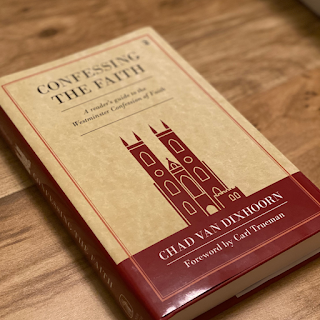
WCF Chapter One "Of Holy Scripture" Sunday School (Sept.-Oct. 2021)

Our text for Sunday School (also "The Confession of Faith and Catechisms") Biblical Theology Bites What is "Biblical Theology...