Showing posts with label Apologetics. Show all posts

Thursday, December 31, 2015

Book Review: Know Why You Believe by Paul E. Little

This review was originally posted on Goodreads.

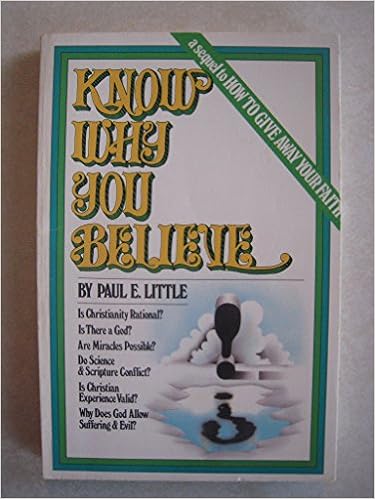
Image Credit: Amazon. I actually read this 1968 version.

I read this book because it was on a "most influential books on evangelicals" list. I can see why it rightly was on that list. First, I'll briefly go over some positives; and then, some negatives.

"Are Miracles Possible?" was filled with tons of information that was new to me -- and the book is over 40 years old. This attests to either the author's creativity or to this reader's ignorance: I'd like to think it is the former.

The political scientists and analysts at the libertarian think-tank The Cato Institute often talk about the states (all 50 of them in the U.S.) as being "laboratories of democracy." Maryland has high taxes; Florida doesn't. New York has ridiculous rent control laws; other states don't. Through these legislative experiments we can see the effect on people. Some people move away from the states with high taxes, and so on.

In a passage Little briefly recalls atheist philosopher John Stuart Mill's view of divine justice via a quote from Hugh Evan Hopkins. If God were just, or if there was a thing as divine justice, then that justice would look like everyone getting their just reward according to their good deeds and bad deeds.

Little then says the most interesting thing to me in the book: "To see the logical consequences of Mill's "exact reward" concept of God in his dealings with man, we need only turn to Hinduism."

And by turning to Hinduism, and the lands effected by Hinduism, we are looking at "laboratories of theology." What are the results of this "exact reward" atheological experiment when the people believe that the god of the universe creates a system based on the thought of John Stuart Mill?

He continues: "The law of Karma says that all of the actions of life today are the result of the actions of a previous life. Blindness, poverty, hunger, physical deformity, outcastness, and other social agonies are all the outworking of punishment for evil deeds in a previous existence. It would follow that any attempt to alleviate such pain and misery would be an interference with the just ways of God. This concept is one reason why the Hindus did so little for so long for their unfortunates."

Then he presses in even more: "Some enlightened Hindus today are talking about and working toward social progress and change, but they have not yet reconciled this new concept with the clear, ancient doctrine of Karma, which is basic to Hindu thought and life."

In short, modern Hindus speak of reform.

But like with reforming Islam, to reform Hinduism its adherents would have to ignore their scripture.

At one point, in the lands given up this to religion, where one doesn't interfere with another person's karma, we saw people in poverty. Moreover, we also saw these countries taking a lot of time to catch up in wealth to Western countries. In contrast, in Christian U.S.A. we see all of the above social agonies being alleviated rapidly, because the Christian worldview allows for charity and entrepreneurship.

"Do Science and Scripture Conflict?" was golden, but it was not flawless. Little mentions certain presuppositions are necessary to science. This is good. However, the doesn't clamp down on the fact that only under the Christian worldview does science work.

Second, the chapter on archaeology and the Bible was a snooze. But I don't think I should be so crass as to say it was a worthless effort. There are people who attempt to discredit the Bible with archaeology, so it is only right that archaeology be covered.

To have written a book on apologetics 40+ years ago and still have insights that are fresh to a seasoned apologetics consumer (meaning I've watched a lot of debates and read a lot of articles on the subject) is an accomplishment.

Stylistically, this book was immensely quotable: I wanted to tweet every other paragraph. The book also simply ends. There is no final review of the cumulative case for Christianity or a concluding chapter.


I'd keep this book on the influential books list.

Thursday, September 17, 2015

K. Scott Oliphint on The Goal of Apologetics

Two things I enjoy about Dr. K. Scott Oliphint are his clarity in defending the Christian faith and his ability to refine his terms. The professor at Westminster Theological Seminary in Philadelphia made the following statements over the years.

"I have no interest of making theists of people because theists go where atheists go." ~Dr. K. Scott Oliphint in his discussion with Richard G. Howe and Jason Lisle on apologetic systems.

"When you are defending the Christian faith, you must defend the Christian faith. You are not simply defending some kind of generic theism." ~Dr. K. Scott Oliphint in his sermon Apologetics in Action: Acts 17:16-34

"The goal of a defense of Christianity is not to win the argument.  It's not an intellectual exercise so that we can show we someone we're smarter than they are. That's not what Paul is doing. The goal is the proclamation of the truth of God and of the Lord Jesus Christ in apologetics." ~Dr. K. Scott Oliphint in his sermon Apologetics in Action: Acts 17:16-34

Wednesday, September 2, 2015

Christians act worse than non-Christians: Bible Edition

"But she [Israel, God's Holy People] has rebelled against my ordinances and statutes, becoming more wicked than the nations and the countries around her, rejecting my ordinances and not following my statutes." ~Ezekiel 5:6 (NRSV)

So basically God anticipated the whole "Christians act morally worse than non-Christians" argument 2,500 years ago.

In other words, it is a given in biblical thought that religious people can indeed act more wicked than those who don't follow that religion...but notice what standard is presupposed.

Sunday, August 9, 2015

K. Scott Oliphint on Sin

Westminster Theological Seminary gives prospective students this meaty little booklet; and, like any good piece of meat, it is packed with the right amount of flavors that are distinctive but not jarringly so. Thus we have Dr. K. Scott Oliphint's essay on "The Irrationality of Unbelief" where he exegetes Romans 1:18-32 and shows the "deep and wide" implications of this passage to Christian apologetics.

He writes: "All sin, as sin, is rooted in an irrationality that seeks in earnest to deny what is obvious and to create a world that is nothing more than a figment of a sinful imagination."

I'd like to take the implications of this a step further: If we are creating a world based on our own vain imaginations, then we should have no problem realizing that the foundations of society are seemlingly turning into sand. No one should expect this kind of society to work.

More on this essay later...

Tuesday, February 17, 2015

Douglas Wilson invites Stephen Fry to a Debate

Via Blog and MaBlog:
Stephen Fry has posed some questions that I believe have some straight-forward answers. I would like to hereby extend a cordial invitation to meet together with him in order to debate them in greater detail. I believe that we could put together an event that put the spotlight on these questions, along with our respective answers.
Fry recently blasted the God of the Bible in an interview.

Sunday, July 20, 2014

Douglas Wilson on "Apologetics and the Heart"

Good reasons, good defenses come from good hearts. If I am only prepared intellectually, I am not prepared intellectually. ~Douglas Wilson
If a man won't obey God in how he treats his wife, then why would he obey God in how he thinks? Rebellion tolerated anywhere will spread everywhere. ~Douglas Wilson
Douglas Wilson's essay "Apologetics and the Heart" is the kind of essay that you should already know the conclusion to but you read it anyway for the edification -- and to see how the author reasons (or exegetes) to the conclusion.

Read it here.

Comment if you have problems with the link.

Friday, July 4, 2014

Harvey Bluedorn's Excellent Insights on Christian Apologetics

From his pamphlet titled "Logical Defense of the Faith":
"To be properly prepared to defend the faith is really to be properly prepared to believe the faith. This is not just an appendix attached to the Christian religion. This is part of the essential Christian life. We should know — or at least be learning — how to defend our faith against all opposition, such that when we are done, our opposition has nothing to say — they are reduced to the assertions of their own imaginations. They will either admit we are speaking the truth, or they will try to shout us down and drown us out, or worse, they will try to put us away. That is the kind of faith in action which drives away the darkness and turns the world around." ~Harvey Bluedorn
"God has so ordained that one of the main components of our argument must be us." ~Harvey Bluedorn
"We can try to diagnose the problem, we can assign the blame, and we can ring our hands all we want about the moral and intellectual decline of American culture, but the fact remains that American Culture is in decline precisely because American Christians have been in retreat." ~Harvey Bluedorn
Everybody has a belief system. They ultimately believe in something. Those beliefs also have consequences.  For he says, "It is an inescapable concept. If we do not believe that we believe anything — then that is what we believe. We have to use our belief in order to deny our belief, and that is what I mean by an inescapable concept."

Lecrae put it this way: "Somebody told me there was no such thing as truth / I said if that's the case then why should I believe you?"
More quotes:
"Only one system of belief, or worldview, can be consistent with reality." ~Harvey Bluedorn

"The unbeliever always borrows from the truth in order to build his system. It is like the man who denied the existence of air — all the way up to his last dying breath!" ~Harvey Bluedorn
Simple questions usually provide enough heat to shine light into the darkness. Questions such as "but isn't that your philosophy" when a man says "we should not live by philosophy" exposes the fact that the man is in fact sharing his philosophy, albeit an embarrassing one.

Other quotes:

"The inductive scientific method can never arrive at truth." ~Harvey Bluedorn

"We do not have to know all of the truth in order to stand on what truth we do know," ~Harvey Bluedorn

Tuesday, April 22, 2014

A not-so-hard question to answer from one atheist blogger

At Patheos, James Croft wrote some years back, recalling a live lecture (2012) on miracles from Ph.D. mathematician and Christian apologist John Lennox:

The Q&A was brief, but I’m glad my question was chosen to be asked: “ If I was to tell you I were just raised from the dead, what evidence would you require to believe it?”
I ask this question of all apologists for Christianity, because it goes right to the heart of the evidentiary claim: what would it take to convince them that someone they encountered today had indeed risen from the dead? There are two common responses: either apologists evade the question, or answer with standards of evidence way higher than the standards of evidence they use when considering the resurrection of Christ.
Apparently, if you go to read on, Dr. Lennox had trouble answering this question.  So I'll take this one.
Prove you were dead.
What could they possibly say in response?
Perhaps around before the publication of atheist philosopher Peter Boghossian's book "A Manual For Creating Atheists," and certainly codified in it, is the notion that Christians will evaluate a piece of evidence against Christianity very critically, so much more than they would examine any other piece of evidence for the veracity of their faith.
In their experience, Christians have had abominably lopsided approaches to evaluating evidence ("A false balance is an abomination to the Lord" Proverbs 11:1; "Do not use dishonest standards when measuring length, strength, or quantity" Lev. 19:35; "Do not have differing weights in your bag--one heavy, one light" Deut. 25:13).
This is, apparently, a common sticking point that atheists have in conversations with Christians, and is fashionable to regurgitate in talks online discussing the alleged implausibility of the Christian faith.
And if John Lennox couldn't answer this simple question, as was reported in the rest of the post that I didn't quote, I submit he was thinking too hard, and sticking too closely to his talking points. And if other Christians haven't been able to answer this question, I submit Christians need a lot more training in critical thinking. 
Putting the onus of proof on himself
So again, prove you were dead. 
His question puts all of the weight on the resurrection part. But his question hasn't even got off the ground yet, and may not ever.
He forgot somebody actually had to die to get there first. And apparently, he forgot he'd also had to prove that his lifeless corpse would have had to have to undergo a certain scientific examination itself -- and then be pronounced dead by the authorities. His metaphorical "tomb" would have to been made known to some folk, which was exactly was known of Jesus's tomb, before he met back up with his disciples to talk about the resurrection that just happened.
I mean, it's a common Christian retort that is beyond cliche territory, but, I mean, you know, he wouldn't want us to take the premise of his question on faith now would he?
And for all of his appeal to our modern sensibilities, you would have at least thought he would have been kind enough to provide his I.D. and death certificate so we could verify. There was no mention of those credentials in his blog.
In the gospel of John, we have a real doubting Thomas who asks a similar question. 
“Unless I see the mark of the nails in his hands, and put my finger in the mark of the nails and my hand in his side, I will not believe.” A week later his disciples were again in the house, and Thomas was with them. Although the doors were shut, Jesus came and stood among them and said, “Peace be with you.” Then he said to Thomas, “Put your finger here and see my hands. Reach out your hand and put it in my side. Do not doubt but believe.” Thomas answered him, “My Lord and my God!” Jesus said to him, “Have you believed because you have seen me? Blessed are those who have not seen and yet have come to believe.” (John 20:25-29 NRSV)
Thomas asked. Thomas received. And this is of course recalled in one of four death certificates, I mean gospels, of Jesus' life. These are the death certificates we show non-believers all the time, and the I.D. where we can read about the life of our Lord, but with much more detail than a 2.5 x 4 I.D card.
Part of the problem with presumptuous, sloppy, and snobbish questions is that they assume too much and prove too little, if anything.
And that is where he went wrong. At least, if you believe in the historical Jesus you would believe that he died by crucifixion and was buried in the tomb of Joseph of Arimathea. Unless, of course, you are one of those types that believes he died and was buried in a shallow pit to be eaten by dogs (bad), or you don't believe in Jesus existed at all (worst). 
Christians have a testimony grounded in history, four separate documents from four separate authors that attest to Jesus' crucifixion, on top of multiple ancient authors to attest to his crucifixion and burial.
This guy has a question backed with the conceit of a college sophomore.
The Close of the Atheist Witness
Reframing the question, if done in a way that oversimplifies the question, looses a few key premises, and then answers a straw man, is definitely unfair, and an abomination unto the Lord, and violates doing unto others as we would have done unto us.
But I do believe the blogger asked a question that needs some work [1]. I do think the question misunderstands some things about resurrections. I know a person who was legally dead (heart stopped) and then was resuscitated by doctors, which is what many of the "resurrections" in the New Testament are like. They are brought back to life to die again. But Jesus is the "first fruits," that is, the first of the resurrection unto immortality. And by definition, this 21st century man claiming to be resurrected can't be. The dead will be raised; flesh will put on immortality; corruption will put on incorruption (1 Corinthians 15:52-54), and all of this will happen at the "Last Trump" (v.52), not right before a Q&A at a John Lennox lecture.
For as in Adam all die, so also in Christ all will be made alive. But each in his own order: Christ the first fruits, after that (Who?) those who are Christ's at (When?) His coming, then comes the end, when He hands over the kingdom to the God and Father, when He has abolished all rule and all authority and power.… (1 Corinthians 5:22-24) [emphasis mine]
Apart from scripture and revelation, which, if true, is intimately linked to past, present, and future history, his question doesn't make any sense. Indeed, his claim to have been resurrected would mean that God is a liar that didn't keep his promise to raise the saints of God on the "Last Day." And that, personally, would raise my eyebrows indeed and warrant my scrutiny.
Indeed, his question can't even make sense in a world where atheism is true because by definition there would be no God to raise him.
On the apologetic method, I didn't even have to worry about who raised you or when were you raised or even begin to answer the question. I just made a simple demand: just prove you were dead. And then after that, prove your theology.
Like the question "Who Made God?" this question, like the former, as John Lennox put that one, is in schoolboy category, because, like how atheists misunderstand the nature of God, this question fundamentally misunderstands the nature of the resurrection.
And according to scripture, I would simply be able to look at him in his glorified body to see if he was resurrected. So would Lennox.
  1. I do think if he reduced his question to the point of simple "miracles" he would have a stronger case. But choosing the specific term "resurrection" he did not. For example, if he reframed it as "If I was to tell you that God performed a miracle in my life, what evidence would you require to believe it?"

Monday, December 30, 2013

New things on the site for 2014

Most of the following are things that I started to do in 2013.

Economics Notes. As I complete my economics courses, I plan on blogging about what I learned in the process. So be prepared to see things about economic philosophy, the Federal Reserve system, the Great Depression, and free-market economics current application to U.S. politics. Because I discontinued my weekly health care posts in late 2012 (see below), I will occasionally, if not frequently, write about solutions to U.S. health care. Similarly, I will also write about the environmental policy occasionally.

Book reviews are in the works as well (see Theology notes section for style).

Theology Notes. I'm not taking any classes, but I do read theology and Christian apologetics books from time to time. And of course, there's always my weekly bible study. I plan on writing reflections on theology and book reviews of theology books. I plan to emulate book reviewers from various sources including Books and Culture, The New Yorker, and The American Spectator, but primarily the first two.

Miscellaneous Notes.  I need some freedom to cover a large range of topics; so to serve that need I will be creating this section. This may cover poetry (I've been reading lots of poetry books), literature (novels, short stories), nutrition, pop culture, Christian culture, philosophy, and journalism, but I really am not sure.


Discontinued in 2013

Last year, I discontinued my "Weekly Health Review," a weekly wrap-up of important health care related news. However, I made it to Vol. 14 before doing so. Overall, those posts were pretty popular features of this site. Looking at the posts' view counts, they ranged from 18-70+ views each, but they mainly were between the 30-40 view range.

Sunday, October 20, 2013

Christopher Hitchens, my home boy, and I

No, that's not me on the right. That's the person I went to the "What Best Explains Reality: Theism or Atheism?" debate with featuring Frank Turek vs. Christopher Hitchens on March 31, 2009 at TCNJ. This was moments after I met Christopher Hitchens for the second time. He had signed the original copy of a 500 word profile of him I wrote for my magazine writing class in Spring 2009.

"Do you have an extra copy?" I recall him asking.

I didn't. And in fact, I thought about leaving him a copy but there wasn't a Kinko's in sight on our way there.

If I remember correctly, I was the last person to have anything signed by Christopher Hitchens that night. It was getting late. Christopher had already signed tons of autographs. And I believe he had a plane to catch.

My homeboy, then a Christian, asked Christopher why he didn't believe in God?

It was one of those, "it's obvious there is a God, why don't you believe in him?"-type questions. It was very passionate.

I don't remember Christopher's response.

But my friend asked him the question as he was still sitting down. I had just stepped away after my paper was signed. Shortly after saying something, Christopher Hitchens stood up, and either he or his help had a gray wheeled luggage bag (or maybe I'm confusing his bag for the one Frank Turek possibly had). He told Christopher about his flight.

That one Christian guy who asks atheists why they don't believe

I was reminded of the entire 2009 TCNJ scene when an old white man, after the Q&A opened up, popped the first question to ask Richard Dawkins at the National Press Club a few weeks ago. Also admittedly an atheist -- at least for that night -- Sally Quinn, a long-time Washington Post reporter and editor, gave one of the worst interviews of Richard Dawkins I've ever seen.

Why do I say that?

Because she steered the conversation to make Richard Dawkins says things that he has literally said 1,000 times before in his speaking and debate circuits after the publication of his 2006 bestseller The God Delusion. We could Wiki some of his answers. This lady is a religion editor. You would have thought she would have done her homework. Maybe she did. Maybe she had done the kind of preparation for a test where the examiner doesn't question you on anything you had studied for. That would be apt, except she was the examiner. And examiner decided to test you on last month's material, which you certainly knew, but were prepared for something more recent (Does this hypothetical ever happen? lol)

Richard Dawkins was there on September 30, 2013 to discuss his new book "An Appetite for Wonder: The Making of a Scientist" (2013), the first half of his two-part memoir. The best she could have done was read excerpts from the book, and then ask him to expound on that.

"What did you mean when you said..." would have been a much more productive way of interviewing than pointing out he became an atheist in his teens (something he has said many times before) and contrasting that with her own awareness that she was an atheist at age 5. Instead, she barely asked about the book, in my view. As I see it, she was a Washington Post reporter getting an exclusive interview with Richard Dawkins and used her exclusive interview to self-servingly get some personal questions answered.

Anyway, after what I guess was a half-hour of virtually unproductive conversation, the Q&A started.

The aforementioned first questioner asked "Why don't you believe in the empirical evidence of the resurrection of Jesus Christ?"

The question brought me back to my friend who asked a similar question with the same underlying vein: "Dear atheist, why don't you see it?"

Thank you for saving me, Richard Dawkins

I respected the question. Both questions. But I must say the following time was spent on two non-questions, a question about when atheism is going to catch on (or something like that) and at least one conspiracy-deny conspiracy theorist. I'll get to the latter in a second.

But a woman explained that she was on the way to the nunnery when she picked up a copy of Richard Dawkins' classic The Selfish Gene, which was even required text for some classes at my alma mater of La Salle University. At that point, she had dropped everything, changed course of her life to one that was religious and would have been completely religious if she had become a nun, and embraced the secular life in all its wonder.

Another man, a former Muslim originally from a Middle Eastern country, explained that it was The Selfish Gene that was the text that changed his outlook on life.

Another guy, who apparently attempted to indulge in some camaraderie before posing his question by, I think, tipping his hat towards The Selfish Gene or maybe some other RD work, asked something to the effect of "What do you think about Government conspiracy?" I believe it dealt with the fact that governments lie. That is true. (I'm sure the question is on tape. That will correct the record.) But there was some brief mention of 9/11 conspiracy theories, but the way it was postulated it was like he was trying to have it both ways. Sure he was secular, maybe even thought of himself as a critical thinker, and whatever he researched in his personal time he may have indeed had some good points, but the way he asked his question was ambiguous, and one wouldn't know if he was pro-conspiracy theory or not (I, for one, think they're OK, if support by facts). Richard was puzzled. So was I.

It also reminds of the way Sally Quinn conducted her interview. Not that her questions had anything to do with conspiracy. They didn't. But I feel like she used the opportunity to ask questions so he could answer and, in effect, do the research for her.

And that's the same way I felt with the guy. Richard Dawkins, by all accounts, is a scientist, not a philosopher of religion, or a political philosopher. (He did mention he wanted to live in a world where people pay taxes, as if taxes were moral things in themselves. In that case, I wouldn't want to live a world that Richard Dawkins gets to construct.) So asking him a political question is kind of intellectually lazy on the questioners part, because it seems like all these people want them to do is give free advice or do the research for the person.

Can we finally--finally!--talk about the book?


In the end, I met Richard Dawkins for the first time. Saw a buddy -- who described himself as "not convinced" by Dawkins and somewhat of "a mystic" -- I recently met a few weeks ago there. And got two RD's signature. It was the only novel thing I got from the experience, and perhaps the only novel thing other attendees got from their experiences. It's not like they could get a novel interview when it's conducted by Sally Quinn. Not that day, at least.

I did entertain a few people waiting in line to get there book signed. And one guy, probably one of the only other black people in the crowd (whether Tea Party rallies or anti-war rallies, politically left or politically right, black people hardly are in the crowds where I do my serious reporting or blogging) recommended I buy Vincent Bugliosi's "The Divinity of Doubt: The God Question." It has been added to my Amazon Wish List.

I ordered The God Delusion a few days before, and so I didn't have the physical copy in front of him to sign. He signed my Amazon receipt instead, which I cut out and pasted into my copy of The God Delusion when it arrived in the mail days later.

The other thing I had RD sign was a printed page of the old Richard Dawkins website. There was a post on there about Richard Dawkins "fleas" (the number of response books to The God Delusion). The blue response book, picture above, is what I originally planned on posting that second RD signature into. I haven't done that yet. The Ipod Tutor: The Argument Against Richard Dawkin's The God Delusion is one of three response books I own. I also own secular Jew, agnostic, and mathematician David Berlinki's book "The Devil's Delusion: Atheism and it's Scientific Pretension's" and Christian and mathematician John Lennox's "God's Undertaker: Has Science Buried God?" I bought all three response books back in college prior to 2011. Perhaps all prior to 2010. I haven't completed one, although I did get through a good portion of Lennox's book back in college, with the highlights, and red and blue ink to show for it. I plan to read all four books soon, meaning within a year or two, starting with the Dawkin's book.

He (RD) was eminently pleasant, by the way.

"Do you want me to sign here?" he said. I was in awe and calmed by his pleasant demeanor.
Monday, June 3, 2013

Antony Flew: Libertarian

Many Christians know of Antony Flew because he was an atheist and debated Christian apologist William Lane Craig and resurrection scholar Gary Habermas. But Flew was also a friend of liberty and an advocate for political and economic freedom.

Here are some of his writings in "The Freeman," a publication of the Foundation for Economic Education.

Sunday, December 11, 2011

William Lane Craig on Atheistic Anti-Humanism

"On atheism there isn't any reason to think that humanism is true. Humanism is a faith commitment to the value of human beings in an atheistic universe.

And here my sympathies are entirely with the atheistic anti-humanists; namely, given atheism, I just don't see any basis to affirm that humanism is true.

Humanism historically is rooted in Christianity. It is because we are made in the image of God that human beings have intrinsic moral worth and God-given human rights. But once you remove God from the picture then all you're left with is the blind evolutionary process with all its contingencies and variabilities and instabilities and no basis for affirming humanism is right after all."
William Lane Craig, Atheistic Anti-Humanism podcast

The podcast was a response to this article: The atheistic critique of humanism has been all but forgotten

WCF Chapter One "Of Holy Scripture" Sunday School (Sept.-Oct. 2021)

Our text for Sunday School (also "The Confession of Faith and Catechisms") Biblical Theology Bites What is "Biblical Theology...