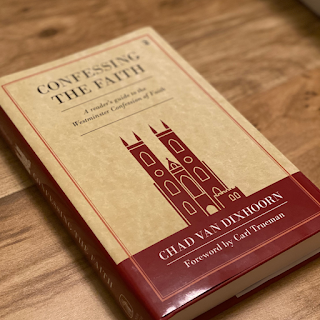
I gotta be honest. I read all the way up to Modern Money Mechanics and didn't finish the rest of the list. But even half the books below and the books above will give you a working economic knowledge for life.
Any citizen will be an economically literate citizen even if he or she reads only half of these books.
These economics books are free for downloading. Read them in this order.
The following is a short list of recommended readings to help students orient
themselves to the theological direction of Northwest Theological Seminary
prior to enrollment. If you have questions concerning readings beyond
this list, please contact the Academic Dean, James T. Dennison, Jr.
Many sermons and articles on the Kerux website (kerux.com)
Geerhardus Vos, Biblical Theology: Old and New Testaments
Herman Ridderbos, Paul: An Outline of His Theology
James T. Dennison, The Letters of Geerhardus Vos
Richard B. Gaffin, By Faith, Not By Sight
Richard B. Gaffin, Resurrection and Redemption
James T. Dennison, "Building the Biblical-theological Sermon,"
Parts 1 and 2 (on the kerux.com website)
Herman Ridderbos, The Coming of the Kingdom
J. Gresham Machen, Christianity and Liberalism
Cornelius Van Til, The Defense of the Faith
A most helpful lecture from J.I. Packer on God's way to holiness.
Relying on the works of John Owen, Packer explains what sanctification is and what it isn't. He clears up many misconceptions, including misconceptions that I had before listening.
Rosaria Butterfield used to live a lesbian lifestyle.
Now, I will spare those who are curious as to whether that means she was in the "gay-as-long-as-I-can-remember" camp. She was not. She got into it pretty late.
But all this means is that she connects with the thousands or millions of people who have embraced homosexual lifestyles post-high school or post-college.
Nevertheless, she is clear, insightful and has a heart for those in the LGBT community.
For one, she, like myself, is against reparative therapy.
"This position contends a primary goal of Christianity is to resolve homosexuality through heterosexuality, thus failing to see that repentance and victory over sin are God's gifts and failing to remember that sons and daughters of the King can be full members of Christ's body and still struggle with sexual temptation. This heresy is a modern version of the prosperity gospel. Name it. Claim it. Pray the gay away."
She is right, and she is taking the biblical view.
My reason for rejecting reparative therapy comes straight from the Bible as well.
Or do you not know that wrongdoers will not inherit the kingdom of God? Do not be deceived: Neither the sexually immoral nor idolaters nor adulterers nor men who have sex with men nor thieves nor the greedy nor drunkards nor slanderers nor swindlers will inherit the kingdom of God.
And that is what some of you were. But you were washed, you were sanctified, you were justified in the name of the Lord Jesus Christ and by the Spirit of our God. (1 Corinthians 6:10-11 NIV)
Almost 2,000 years ago, people were, before the arrival of modern technology, dealing with homosexual attraction and having homosexual intercourse. And, by the grace and Spirit of our God, they were washed and sanctified from their sins -- sex-related or not. Notice the inclusion of all kinds of sins in the passage.
No doctors, except the Great Physician, were present.
No medical contraptions, no weird methods or instruments designed to make a gay person straight were used.
It's also worthy pointing out what comes next:
The body, however, is not meant for sexual immorality but for the Lord, and the Lord for the body. By his power God raised the Lord from the dead, and he will raise us also. Do you not know that your bodies are members of Christ himself? (1 Corinthians 6:13-15 NIV)
God's power, the same power that lifted the Lord Jesus from the grave, will lift us also in the Resurrection.
She also makes book recommendations. I trust them.
When I was a senior in college, I wrote the second-longest essay of my life -- and it wasn't for a class. It was for a cash prize of $5,000.
In December 2009, I heard about the Atlas Sound Money Project Essay and, broke as the economy, I jumped for the cash prize. I did not win the first prize. A kid from Dartmouth did, if my memory serves me correctly. I also did not win the one of the two second prizes ($1,000), or one of the three third prizes ($500).
I had to choose between the following topics:
Essay Topics:
- “Money and the Free Society: Can Money Exist Outside of the State?”
- “The Ethical Implications of Monetary Manipulation”
- “Monetary Policy and the Rule of Law in the United States”
I choose the last one.
But cleaning up my desk this evening (how it surfaced to my desk 4 years later, I have no idea), I decided to discard the paper I had notes on and preserve the memory through this blog post.
Here are the books I used to write the 20-page essay, which was supposed to be "accessible to the educated laymen, but rigorous enough as to be used in college and university courses." That had my writing style written all over it.
Economics Reading List for Sound Money Essay
-The Alpha Strategy
-How the Fed Works (50 pages)
-Essentials of Economics
-Gold Wars
-Honest Money (Esp. Biblical Monetary System)
-Housing Boom and Bust
These aren't the only sources I used. I also completed Robert P. Murphy's "Politically Incorrect Guide to Capitalism," some excerpts from some newsletters I was receiving at the time, and more. Besides the Murphy book, only other books I read in their entirety for this essay was "The Alpha Strategy" (which I have offered free of charge since November 2009), "Gold Wars," "Honest Money." I skimmed through the Sowell Book. I probably didn't cite the Faustino Ballve book nor the How the Fed Works book.
I also have some handwritten notes on this paper, such as "banks are good - fractional reserve isn't," "sell back gold to the public," "FDIC out of commission," "FED = Insurance Agency," "prevent recessions," "prices of goods will fall," "gov = tax in gold," " = pay in gold," and "no government mandate for gold-only. Gold is standard, but other metals are usuable (sic)." Corresponding page numbers were in parentheses next to these notes.
Stauffer's Christ and the Caesars (Economics) Cochrane's Christianity and Classical Culture (Philosophy and Ethics) Anything Rodney Stark (Early Church)