Showing posts with label Jesus. Show all posts

Thursday, September 16, 2021

Announcement: I am a Sunday School Teacher Now!!!

Me @ RTS (Mclean, VA) on April 26, 2014 for an open house.

A couple of weeks ago my pastor asked me if I would be willing to teach the high schoolers and middle schoolers at our church in Sunday School. I gladly said I would consider it, and ultimately accepted the offer.

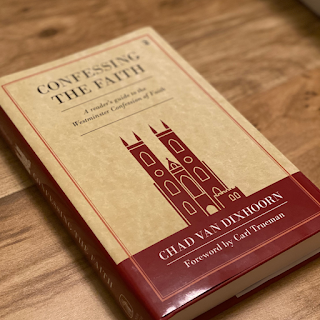
So I am pleased to announce I will be teaching The Westminster Confession of Faith and using "Confessing the Faith: A Reader's Guide to the Westminster Confession of Faith"  (2014) by Chad Van Dixhoorn of Reformed Theological Seminary starting on Sunday, September 19, 2021.

The topic was the pastor's choosing.

My copy I just received last Sunday!

What's interesting is that the year this book was published I visited, but ultimately did not apply to, Reformed Theological Seminary. I can't recall if I met the author. I did, however, meet some of his colleagues mentioned in the book, such as Peter Lee of RTS and Scott Redd.

I will be publishing my weekly Sunday School Notes here at The Goins Report. 

These will be references for my students but also general readers who want to follow along with both the Confession of Faith book by Dixhoorn and the actual Confession of Faith text itself.

While this series will not initially be recorded, it may be recorded in the future, or the next go around.

However, I plan to have a couple of video series (potentially on Youtube or Udemy at no cost, initially; or some free and some at low-cost) potentially on the following topics:

  • The Evidence of Christianity and the Evidence of Prophecy
  • Loving the Old Testament
  • Biblical Theology
  • Sermon on the Mount 

P.S. I am a huge, huge fan of Biblical Theology as my growing collection of BT books attests to. But my first introduction wasn't an explicitly BT book per se. It was this one. The introduction and the first chapter are gold. And then some people at my church also introduced me to the now-defunct Northwest Theology Seminary which has a BT Primer on their website

Jesus to Kingdom Citizens: Worrying flows from Serving Mammon


Jesus made it very clear that those who worry about their life and food and clothing end up serving money.

Disciples of the King are not supposed to not worry about these things.

Those who worry are the Gentiles — those outside of the promises of God.

“No one can serve two masters …You cannot serve God and mammon." 

He immediately follows this with “therefore,” as in “therefore do not worry about your life,” thus connecting the "do not worry" statement to the preceding statement about serving either God or money. The love of money is the root of all kinds of evil. And love of money can cause you to support all kinds of evil power structures.

Here is the full text of Matthew 6:24-33 (NKJV):

“No one can serve two masters; for either he will hate the one and love the other, or else he will be loyal to the one and despise the other. You cannot serve God and mammon. “Therefore I say to you, do not worry about your life, what you will eat or what you will drink; nor about your body, what you will put on. Is not life more than food and the body more than clothing? “Look at the birds of the air, for they neither sow nor reap nor gather into barns; yet your heavenly Father feeds them. Are you not of more value than they?

“Which of you by worrying can add one cubit to his stature?

“So why do you worry about clothing? Consider the lilies of the field, how they grow: they neither toil nor spin;

“and yet I say to you that even Solomon in all his glory was not arrayed like one of these.

“Now if God so clothes the grass of the field, which today is, and tomorrow is thrown into the oven, will He not much more clothe you, O you of little faith?

“Therefore do not worry, saying, ‘What shall we eat?’ or ‘What shall we drink?’ or ‘What shall we wear?’

“For after all these things the Gentiles seek. For your heavenly Father knows that you need all these things.

“But seek first the kingdom of God and His righteousness, and all these things shall be added to you.

“Therefore do not worry about tomorrow, for tomorrow will worry about its own things. Sufficient for the day is its own trouble.

Here is the full text of 1 Timothy 6:10 (NKJV):
"For the love of money is a root of all kinds of evil, for which some have strayed from the faith in their greediness, and pierced themselves through with many sorrows."

P.S. Matthew 6:33 is my favorite scripture. I read it or recite it every night right before I close my eyes to rest. 

Friday, April 8, 2016

This sermon on Hell did not end the way I thought it would


I'm serious. Scot McKnight, author of The Jesus Creed, sketches the predominant views of Hell (eternal punishment) today and then preaches on the parable of the rich man in Hades (Luke 16:14-31) and comes to his own conclusion. He distinguishes between the NT Greek terms Hades and Gehenna.


Watch it from beginning to end.

Tuesday, February 16, 2016

Nina Simone didn't get it -- or at least her interpreters don't


Nina Simone didn't get it -- or at least the people interpreting her. Let's go with the latter. I feel better not insulting a legend who was hip to so many issues.

"An artist's duty, as far as I am concerned, is to reflect the times."

The problem is people read in "being conscious" here. But not everybody is "woke" or wants to be, and our music and media reflects that, even from people who call themselves "artists."

Plus, "woke" is a relative term.

One can be "woke" to all kinds of things and dead to the reality of the resurrection of Jesus Christ, for example, and his now-Kingship, his love, his mercy, his forgiveness, and the life-changing Holy Spirit which helps us walk in that love.

Wednesday, March 25, 2015

Scot McKnight: Don't ever ask Jesus a question

Don't ever ask Jesus a question, says American theologian Scot McKnight:


…Jesus is confronted by a scribe who comes to him and says ‘of all the commandments which is the greatest of them all.’ Now here is one thing I’ve learned in studying the gospels: don’t ever ask Jesus a question. Because he will not only answer your question, he will deconstruct you in the process. ~Scot McKnight
He originally said that here.

Tuesday, March 24, 2015

Video: 5 Minute Sermons - A Transformed Life


I wanted to hear something quick but biblical before I started my work last Friday so I googled "5 minute sermons." This is the first thing that popped up on the Google Search -- and I must say that it is very good!

Sunday, February 22, 2015

Jesus is the prince of peace; Christians are supposed to follow him 24/7

"It honestly has just astounded me in the last three decades how many good Christian kids have, without a flinch of conscience, marched off to fight in Afghanistan or Iraq or elsewhere. I don’t think they got the memo about what the Sermon on the Mount actually says on things like non-violence, love, forgiveness, non-resistance, loving enemies and the like. Jesus intended for his followers to imitate his own behavior, not that of Caesar and his legions. 
If only for the sake of putting the emphasis on the right syllable, Christians ought to be going out of their way to distinguish themselves from their more bellicose neighbors and friends. They ought to be setting a better example of the more excellent way of loving one’s neighbors, even one’s enemies, and I’m pretty sure when Jesus said love your enemies he didn’t mean love them to death at the point of a gun. 
 For me this means three things at the personal level: 1) I can’t serve in the military, except perhaps as a medic or maybe a chaplain, although I am not even sure that might not be too much of a compromise; 2) it means I must spend my life on positive Gospel tasks, not negative destructive ones. My focus and life style and views must be entirely different from that of perhaps the majority of Americans on these matters; 3) it means that I must support those Jesus says are blessed— the peacemakers." 

 Ben Witherington III, "The Prince of Peace - Part One"

Tuesday, January 13, 2015

WWJD about North Korea and the Sony Hack


WWJD (What would Jesus do) about the U.S. deciding to retaliate against North Korea for its alleged hacking of Sony? While the "just war" tradition is helpful, there's a quicker way to get to the point.

Here's a deductive syllogism from the Bible.

A) Jesus believed that the Torah was authoritative (The Torah is the Five Books of the Bible), per Matthew 5:17-19.

B) The Torah says "thou shall not bear false witness against your neighbor." (Exodus 20:16)

C) The U.S. government manufactured evidence of North Korean culpability.

D) Manufacturing evidence is bearing false witness (false testimony) against your neighbor.

E) Conclusion: Jesus would not have supported retaliation against North Korea.

This syllogism avoids questions of "what kind of force is appropriate," "are sanctions appropriate," as the very premises of the government's arguments are undermined.  "Who would Jesus bomb" is irrelevant here.

Why?

The accused are not guilty.

Thursday, January 8, 2015

Jesus' coming in judgment (Part 1)

In "Is Jesus Coming Soon," Gary Demar writes:
How is it possible that Jesus "came in A.D. 70? We must allow Scripture to interpret Scripture and evaluate what "coming" means in parallel passages.  Throughout the Old Testament, God "came" in judgment (Gen 11:5; Ex. 3:8; 19:9; 34:5, Psalm 18:6-17; 72:6; 104:3; Isa. 19:1-4; 31:4; Micah 1:3-5: Mal. 3:5).
As anyone can see Demar is not short on scriptural support. But he continues:
In addition, the New Testament speaks of Jesus' coming in judgment (Matt 10:23; 16:27-28; 26:27-28; 26:64; Mark 14:61-62). Notice how many times Jesus threatens to judge the churches of Asia Minor by His coming (Rev. 2:5, 16; 3:3).
At that point I had to write "good point" in the margin of my copy. But here is why:
 It makes no sense if the coming referred to in these verses is a distant coming. The threatened comings are local and particular to a certain period of time and place.

Tuesday, April 22, 2014

A not-so-hard question to answer from one atheist blogger

At Patheos, James Croft wrote some years back, recalling a live lecture (2012) on miracles from Ph.D. mathematician and Christian apologist John Lennox:

The Q&A was brief, but I’m glad my question was chosen to be asked: “ If I was to tell you I were just raised from the dead, what evidence would you require to believe it?”
I ask this question of all apologists for Christianity, because it goes right to the heart of the evidentiary claim: what would it take to convince them that someone they encountered today had indeed risen from the dead? There are two common responses: either apologists evade the question, or answer with standards of evidence way higher than the standards of evidence they use when considering the resurrection of Christ.
Apparently, if you go to read on, Dr. Lennox had trouble answering this question.  So I'll take this one.
Prove you were dead.
What could they possibly say in response?
Perhaps around before the publication of atheist philosopher Peter Boghossian's book "A Manual For Creating Atheists," and certainly codified in it, is the notion that Christians will evaluate a piece of evidence against Christianity very critically, so much more than they would examine any other piece of evidence for the veracity of their faith.
In their experience, Christians have had abominably lopsided approaches to evaluating evidence ("A false balance is an abomination to the Lord" Proverbs 11:1; "Do not use dishonest standards when measuring length, strength, or quantity" Lev. 19:35; "Do not have differing weights in your bag--one heavy, one light" Deut. 25:13).
This is, apparently, a common sticking point that atheists have in conversations with Christians, and is fashionable to regurgitate in talks online discussing the alleged implausibility of the Christian faith.
And if John Lennox couldn't answer this simple question, as was reported in the rest of the post that I didn't quote, I submit he was thinking too hard, and sticking too closely to his talking points. And if other Christians haven't been able to answer this question, I submit Christians need a lot more training in critical thinking. 
Putting the onus of proof on himself
So again, prove you were dead. 
His question puts all of the weight on the resurrection part. But his question hasn't even got off the ground yet, and may not ever.
He forgot somebody actually had to die to get there first. And apparently, he forgot he'd also had to prove that his lifeless corpse would have had to have to undergo a certain scientific examination itself -- and then be pronounced dead by the authorities. His metaphorical "tomb" would have to been made known to some folk, which was exactly was known of Jesus's tomb, before he met back up with his disciples to talk about the resurrection that just happened.
I mean, it's a common Christian retort that is beyond cliche territory, but, I mean, you know, he wouldn't want us to take the premise of his question on faith now would he?
And for all of his appeal to our modern sensibilities, you would have at least thought he would have been kind enough to provide his I.D. and death certificate so we could verify. There was no mention of those credentials in his blog.
In the gospel of John, we have a real doubting Thomas who asks a similar question. 
“Unless I see the mark of the nails in his hands, and put my finger in the mark of the nails and my hand in his side, I will not believe.” A week later his disciples were again in the house, and Thomas was with them. Although the doors were shut, Jesus came and stood among them and said, “Peace be with you.” Then he said to Thomas, “Put your finger here and see my hands. Reach out your hand and put it in my side. Do not doubt but believe.” Thomas answered him, “My Lord and my God!” Jesus said to him, “Have you believed because you have seen me? Blessed are those who have not seen and yet have come to believe.” (John 20:25-29 NRSV)
Thomas asked. Thomas received. And this is of course recalled in one of four death certificates, I mean gospels, of Jesus' life. These are the death certificates we show non-believers all the time, and the I.D. where we can read about the life of our Lord, but with much more detail than a 2.5 x 4 I.D card.
Part of the problem with presumptuous, sloppy, and snobbish questions is that they assume too much and prove too little, if anything.
And that is where he went wrong. At least, if you believe in the historical Jesus you would believe that he died by crucifixion and was buried in the tomb of Joseph of Arimathea. Unless, of course, you are one of those types that believes he died and was buried in a shallow pit to be eaten by dogs (bad), or you don't believe in Jesus existed at all (worst). 
Christians have a testimony grounded in history, four separate documents from four separate authors that attest to Jesus' crucifixion, on top of multiple ancient authors to attest to his crucifixion and burial.
This guy has a question backed with the conceit of a college sophomore.
The Close of the Atheist Witness
Reframing the question, if done in a way that oversimplifies the question, looses a few key premises, and then answers a straw man, is definitely unfair, and an abomination unto the Lord, and violates doing unto others as we would have done unto us.
But I do believe the blogger asked a question that needs some work [1]. I do think the question misunderstands some things about resurrections. I know a person who was legally dead (heart stopped) and then was resuscitated by doctors, which is what many of the "resurrections" in the New Testament are like. They are brought back to life to die again. But Jesus is the "first fruits," that is, the first of the resurrection unto immortality. And by definition, this 21st century man claiming to be resurrected can't be. The dead will be raised; flesh will put on immortality; corruption will put on incorruption (1 Corinthians 15:52-54), and all of this will happen at the "Last Trump" (v.52), not right before a Q&A at a John Lennox lecture.
For as in Adam all die, so also in Christ all will be made alive. But each in his own order: Christ the first fruits, after that (Who?) those who are Christ's at (When?) His coming, then comes the end, when He hands over the kingdom to the God and Father, when He has abolished all rule and all authority and power.… (1 Corinthians 5:22-24) [emphasis mine]
Apart from scripture and revelation, which, if true, is intimately linked to past, present, and future history, his question doesn't make any sense. Indeed, his claim to have been resurrected would mean that God is a liar that didn't keep his promise to raise the saints of God on the "Last Day." And that, personally, would raise my eyebrows indeed and warrant my scrutiny.
Indeed, his question can't even make sense in a world where atheism is true because by definition there would be no God to raise him.
On the apologetic method, I didn't even have to worry about who raised you or when were you raised or even begin to answer the question. I just made a simple demand: just prove you were dead. And then after that, prove your theology.
Like the question "Who Made God?" this question, like the former, as John Lennox put that one, is in schoolboy category, because, like how atheists misunderstand the nature of God, this question fundamentally misunderstands the nature of the resurrection.
And according to scripture, I would simply be able to look at him in his glorified body to see if he was resurrected. So would Lennox.
  1. I do think if he reduced his question to the point of simple "miracles" he would have a stronger case. But choosing the specific term "resurrection" he did not. For example, if he reframed it as "If I was to tell you that God performed a miracle in my life, what evidence would you require to believe it?"

Monday, March 10, 2014

Video: Lifehouse's Everything Skit


I first saw this video about seven years ago in 2007. I watched it again for the first time in a very long time today. I cried.

Saturday, February 22, 2014

No, Republican Tom Delay. God is not the author of the U.S. Constitution

The Huffington Post reports:
Former House Majority Leader Tom DeLay (R-Texas) urged Americans to realize that God “wrote the Constitution” and predicted an upcoming “awakening” during an interview on John Hagee Ministries’ Global Evangelism Television network on Wednesday.
“I think we got off the track when we allowed our government to become a secular government,” DeLay told host Matthew Hagee, the executive pastor of the Texas Cornerstone Church. “[W]e stopped realizing that God created this nation, that he wrote the Constitution, that it’s based on biblical principles.”
No sir, God did not write something that would fundamentally reject his rule.

Steve Halbrook of Theonomy Resources somewhat explains:
He rightfully opposes today's secular humanist approach to civil governmentwhich to one degree or another has infected most of American Christianity. This is indeed an area that needs reformation. He also rightfully points out the anti-Christian nature of the U. S. Constitution; not that we deny that it is has some good procedure law, but it is at the very least dishonoring to Jesus Christ in its neglect of recognizing Him as the highest political authority in the land. (Covenanters pointed out this fatal flaw long ago.) 

God is like a mother waiting for her child to return home

God is like that mother who waits for her child to come back home from playing outdoors and makes sure the child gets washed up, nourished and ready for the next day. (Late Elementary & Middle school memories of my Mom waiting at the front door with the door wide open come to mind here)

Of course, in some sense that's where the analogy ends because kids should totally play outside. But we who know the Lord Jesus Christ have someone ready to clean us when we get dirty in sin from time to time. ~The Proprietor

Monday, September 2, 2013

Joel McDurmon on What Christians Should be Doing on Syria

Via Joel McDurmon of The American Vision:
If you really care about Syria, Iraq, Afghanistan, Egypt, Libya and every other hell-hole governed by a despot or in the grip of civil war, there is only one appropriate response. You pray to the God who makes wars to cease from the ends of the earth to bring peace (Psalm 46:9); pray for the gospel to take root and flourish in those nations; and send out missionaries there if you can. These are the only weapons that will ever do those places any good. All others will reap yet more destruction and misery in the years to come and our nations will bear much of the responsibility for it.
I'd like to add, "Can any of you by worrying add a single hour to his life?" (Matthew 6:27)

Sunday, July 28, 2013

The Single Most Important Essay of My Undergraduate Career

The most important essay I was assigned to read in undergrad and definitely the most influential passage is excerpted below. I found the Bach analogy beautiful:
 "If these historical realities are not taken into account, if the texts are not encountered in all of their historicality, then there is no understanding, either of the texts as texts or of the apostle from whom they have come. What Isaac Stern once said about playing a Bach violin concerto also applies to understanding Paul and his letters. Various interpretations, he said, can be called "right"; but equally, many interpretations have to be called "wrong." No reading of a text, whether from Bach or from Paul, that neglects its historicality--that is heedless of its origins, genre, form, structure, and intentions, however imperfectly these may be discerned--can be credibly called an interpretation of that text. Whether engagement with the text and a concern to understand its claims are subordinated to an interest, say, in "the effects of reading" it, or whenever the text is simply taken over for one's own purposes, whether theological, aesthetic, or political, then the text is not being interpreted but confiscated. An interpreter must be, first of all, an advocate for the text."
 Furnish, Victor P. "On Putting Paul In His Place." Journal of Biblical Literature 113.1 (1994): 12-13.

Monday, June 3, 2013

Antony Flew: Libertarian

Many Christians know of Antony Flew because he was an atheist and debated Christian apologist William Lane Craig and resurrection scholar Gary Habermas. But Flew was also a friend of liberty and an advocate for political and economic freedom.

Here are some of his writings in "The Freeman," a publication of the Foundation for Economic Education.

WCF Chapter One "Of Holy Scripture" Sunday School (Sept.-Oct. 2021)

Our text for Sunday School (also "The Confession of Faith and Catechisms") Biblical Theology Bites What is "Biblical Theology...