Showing posts with label N.T. Wright. Show all posts
Tuesday, March 8, 2016
Thursday, December 18, 2014
The Challenge of a Changing World
"God's Word does not change. God's world, however, changes in every generation. These changes, in addition to new findings by scholars and a new variety of challenges to the gospel message, call for the church in each generation to interpret and apply God's Word for God's people." The Editors of The New American Commentary: Proverbs, Ecclesiastes, Song of Songs
Similar things are said in N.T. Wright's foreword to "The King Jesus Gospel: The Original Good News Revisited."
Wright says that "[p]art of the genius of genuine Christianity is that each generation has to think it through afresh. Precisely because (so Christians believe) God wants every single Christian to grow up in understanding as well as trust, the Christian faith has never been something that one generation can sort out in such a way as to leave their successors with no work to do."
He continued: "Like a young man inheriting a vast fortune, such a legacy could just make you lazy. All you'd have to do would be to look up things in the book, or to remember how it was when your favourite pastor used to do it, and that would be it. No room for character. No room for full human maturity--never mind full Christian maturity."
Monday, June 30, 2014
Video: N.T. Wright on the definition of the Gospel
N.T. Wright makes similar comments in the foreword of Scot McKnight's "The King Jesus Gospel: The Original Good News Revisited." Pick it up.
Monday, March 31, 2014
Why the rapture scenario you've been taught is wrong
[Editor's Note: I unpublished this a few days ago because I wanted to work more on the N.T. Wright part. I am now republishing it without the changes. I do, however, want to work on the N.T. part more but I'd rather re-edit this post at a future date or post an entirely new post in the future. ~The Editor, 4/22/14]
But I recently had a conversation with a young believer a few nights ago and that conversation eventually turned to the rapture.
We spoke about my long-held desire that some celebrities give their life over to the Lord Jesus Christ. But this person then said that Satan once controlled the music in heaven, and therefore strongly influences the music culture today. The former is belief, by the way, that is held on popular Christian websites such as this one. She pretty much then expressed that the satanic influence over their lives is so powerful that they won't even have the possibility to repent and be saved until after the rapture.
Once they see that, once they get the seriousness of God, and the evidence of him, then they will turn and repent. After the rapture, she explained, "it will be hell on earth." She then pointed me to the book of Revelation.
It reminded me of talking to one of my homeboys (the same homeboy in this post) back in the day when I criticized the rapture then. Why would God rapture all the Christians away and leave all the unbelievers to perish in a "hell on earth" for years on end? Why wasn't anyone left behind to preach to them? And a new question to my friend, where is their rapture? Wouldn't Jesus need to make a third and fourth coming? Would Paul and Jesus preached about a resurrection for the righteous and wicked and then another resurrection for the repentant? My questions are ultimately inconsequential to God's will. God's ways are not my ways. I recognize that. But these seem to be legitimate questions.
And then, she did it. She mentioned the Left Behind Series. No, I did not see it, I replied. Nor have I read the books. But in 2010 I did catch the Catholic Defamation League's review of it. The author of that 2004 post had this wonderful thing to say:
But all of this haphazard interpretation of scripture that concerns me. My view of the rapture is, I'd like to believe, the scriptural one. Generally speaking, I am in the late Greg L. Bahnsen's camp on this one. But I also took a peek at N.T. Wright camp grounds, too. I'm using binoculars to scout it out, so I'm keeping my distance.
Bahnsen taught that the rapture, the resurrection of the saints and the wicked, all pretty much happen on the Last Day.
Here's the conclusion (but you're going to want to read how he arrived at that conclusion):
Next up, the troubling stuff.
Troubling passage #1:
N.T. Wright's article "Farewell to the Rapture" should be read immediately after Bahnsen's. He provides an in-depth look at the Old Testament imagery Paul is borrowing as well as some imagery from the first century. Here's a pertinent passage:
Bahnsen, writing nearly 30 years before Wright, wins on clarity. Wright simply raises more questions. I think Bahnsen does more to refute the dispensationalist rapture position. Wright doesn't puncture the skin.
Read the rest of N.T. Wright's "Farewell to the Rapture" (2001) article here.
The American obsession with the second coming of Jesus — especially with distorted interpretations of it — continues unabated. Seen from my side of the Atlantic, the phenomenal success of the Left Behind books appears puzzling, even bizarre. Few in the U.K. hold the belief on which the popular series of novels is based: that there will be a literal “rapture” in which believers will be snatched up to heaven, leaving empty cars crashing on freeways and kids coming home from school only to find that their parents have been taken to be with Jesus while they have been “left behind.” This pseudo-theological version of Home Alone has reportedly frightened many children into some kind of (distorted) faith. N.T. Wright, "Farewell to the Rapture" (2001)I made a mistake in a previous blog post. I do believe in the rapture. I just don't believe in the rapture as generally preached by many dispensationalist pastors, including my own pastor. Yes, I attend a church where I question the theology quite a bit. And I've spoken to people outside the church about this matter; and surprisingly, they've asked "do you think this is the place God has placed you?" I think the answer is a resounding yes. In short, I think I've been placed there to change things a little bit.
But I recently had a conversation with a young believer a few nights ago and that conversation eventually turned to the rapture.
We spoke about my long-held desire that some celebrities give their life over to the Lord Jesus Christ. But this person then said that Satan once controlled the music in heaven, and therefore strongly influences the music culture today. The former is belief, by the way, that is held on popular Christian websites such as this one. She pretty much then expressed that the satanic influence over their lives is so powerful that they won't even have the possibility to repent and be saved until after the rapture.
Once they see that, once they get the seriousness of God, and the evidence of him, then they will turn and repent. After the rapture, she explained, "it will be hell on earth." She then pointed me to the book of Revelation.
It reminded me of talking to one of my homeboys (the same homeboy in this post) back in the day when I criticized the rapture then. Why would God rapture all the Christians away and leave all the unbelievers to perish in a "hell on earth" for years on end? Why wasn't anyone left behind to preach to them? And a new question to my friend, where is their rapture? Wouldn't Jesus need to make a third and fourth coming? Would Paul and Jesus preached about a resurrection for the righteous and wicked and then another resurrection for the repentant? My questions are ultimately inconsequential to God's will. God's ways are not my ways. I recognize that. But these seem to be legitimate questions.
And then, she did it. She mentioned the Left Behind Series. No, I did not see it, I replied. Nor have I read the books. But in 2010 I did catch the Catholic Defamation League's review of it. The author of that 2004 post had this wonderful thing to say:
The Left Behind books and their non-fiction companions are filled with poor writing, bad theology, and anti-Catholic bigotry. It’s best to leave them behind and rely on Scripture, Tradition, and the Magisterium of the Church when studying the end times—or anything else.Oh yea, I also played the awful video game too.
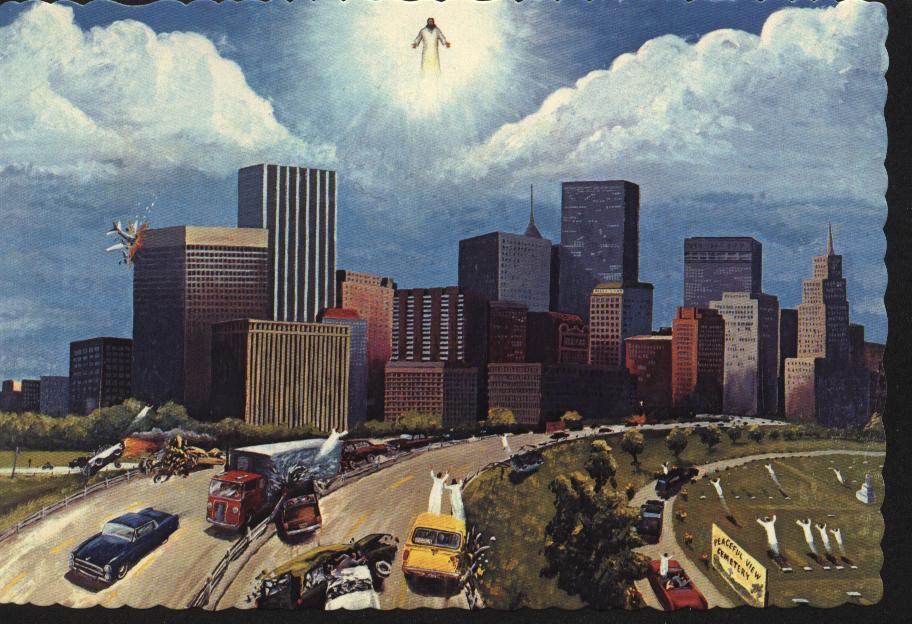
But all of this haphazard interpretation of scripture that concerns me. My view of the rapture is, I'd like to believe, the scriptural one. Generally speaking, I am in the late Greg L. Bahnsen's camp on this one. But I also took a peek at N.T. Wright camp grounds, too. I'm using binoculars to scout it out, so I'm keeping my distance.
Bahnsen taught that the rapture, the resurrection of the saints and the wicked, all pretty much happen on the Last Day.
Here's the conclusion (but you're going to want to read how he arrived at that conclusion):
We must conclude from God’s word that the rapture will not eventuate prior to the very last day of history, that it will not leave behind the world of the wicked, and that it will not separated from the resurrection and judgment of the wicked. The pre-tribulational rapture seven (or three and a half) years before the Lord’s return is contrary to the teaching of the bible. Furthermore, it must be noted that the rapture of the saints will be anything but a secret event; it will be accompanied with the shout of Christ, the voice of the archangel, and the trump of God (I Thess. 4:16-17). Nobody will miss it.Read the rest of Greg L. Bahnsen's "Rapture and Resurrection" (1975) here.
N.T. Wright is a little bit less clear (not a surprise) and disagreeable but helpful. He does say the following up front, which lets us know he still believes in the essential stuff: "The Ascension of Jesus and the Second Coming are nevertheless vital Christian doctrines, and I don’t deny that I believe some future event will result in the personal presence of Jesus within God’s new creation." In this article, he doesn't mention the Last Day, and seems to downplay being caught up in the air.
Next up, the troubling stuff.
Troubling passage #1:
Paul’s mixed metaphors of trumpets blowing and the living being snatched into heaven to meet the Lord are not to be understood as literal truth, as the Left Behind series suggests, but as a vivid and biblically allusive description of the great transformation of the present world of which he speaks elsewhere. (emphasis mine)I agree with this on some level, because Matthew 24 borrows heavily from various Old Testament Prophets. And "coming" really refers to a judgment in those instances. It's not a literal "coming" like you are coming back to town in your 2-door coupe.
N.T. Wright's article "Farewell to the Rapture" should be read immediately after Bahnsen's. He provides an in-depth look at the Old Testament imagery Paul is borrowing as well as some imagery from the first century. Here's a pertinent passage:
Third, Paul conjures up images of an emperor visiting a colony or province. The citizens go out to meet him in open country and then escort him into the city. Paul’s image of the people “meeting the Lord in the air” should be read with the assumption that the people will immediately turn around and lead the Lord back to the newly remade world. (Emphasis in italics mine)I sorely want to agree with this, especially with the leading the Lord "back to the newly remade world" part. But where in this passage does Paul conjure up this imagery? I think the strongest thing Wright did to cast doubt on the dispensationalist position was in the leading paragraph in his article (and this article) that I quote above.
Bahnsen, writing nearly 30 years before Wright, wins on clarity. Wright simply raises more questions. I think Bahnsen does more to refute the dispensationalist rapture position. Wright doesn't puncture the skin.
Read the rest of N.T. Wright's "Farewell to the Rapture" (2001) article here.
Saturday, January 11, 2014
On the apologetic abilities of ex-believers
“Bart Ehrman’s career is testament to the fact that no one can slice and dice a belief system more surgically than someone who grew up inside it.” —Salon.com via New Testament scholar Bart Ehrman's old website.
There is a lot of truth to this maxim; but its applicability, as it suggests, extends far beyond just ex-Christians like Ehrman. It even extends beyond religion.
Thomas Sowell, for example, was a marxist that didn't come around to free-markets until he saw his god, his economic religious system, his beliefs he was immersed in, fail. This happened while he was interning for the U.S. federal government in the Department of Labor (I think).
He now is, as he has been for decades, dismantling the left-wing worldview in his weekly columns and books.
American humorist P.J. O' Rourke was also a man of the left, until he got a job, he's quipped a few times.
Christopher Hitchens, whom I will mention again below, was once a committed Trotskyist and socialist in the 1970s and 80s and later came to embrace, well, something.
It's not clear that he is writing approvingly, but in the foreword to Choice: The Best of Reason, Hitchens writes:
Ex-Christians turned atheists, Ex-atheists turned Christians
There are also many ex-atheists who spend much of their life dedicated to sharing the gospel of Jesus and God's coming kingdom to unbelievers. C.S. Lewis, whom I've never actually read yet, except for that liar, lunatic, or Lord line,* comes to mind (I don't think that's too much of a simplification of my past).
Lewis, went on to write many books defending Christianity, such as Mere Christianity, and creatively shared the Christian worldview in his works of fiction, the most notable probably being the Chronicles of Narnia series. (I hear the space trilogy series is pretty good too.)
Some less prominent examples such as David Wood and former Ex-Atheist.com proprietor A.S.A. Jones; others include Peter Hitchens, Alister McGrath, Francis Collins, John Harwick Montgomery, Marvin Olasky, and novelist A.N. Wilson.
Heck, even the late philosopher Antony Flew, who did not become a Christian his last years, became a deist (his words), and put out a book about how he believes in God, albeit a sort of "Aristotelean god."
Richard Dawkins and the late Christopher Hitchens and are on the opposite end of the spectrum. Dawkins admitted to losing his "last vestiges of religious faith" (if I can recall that correctly from The God Delusion Debate DVD with John Lennox) in his teenage years; Hitchens, in his adolescence (around 9).
Dawkins was actually very explicit about why he believed as a young Christian. Via Wikipedia:
In other words, he spent his career "surgically" explaining away design -- the very thing he used to believe in.
[Editor's Update January 13, 2013 7:30 PM] It's somewhat of a genetic fallacy to say that because someone is an ex-believer in some religious belief or some economic philosophy, such as those mentioned above, that their new beliefs are true. However, the fact that they did leave one faith and now believe in something else should raise some eyebrows.
*I know Lewis is not actually quoted in that link. However, I decided to link to perhaps one of the first websites that introduced that line of argument to me; The Case For Christ DVD possibly being the other source for me.
Wikipedia has the quote in it's entirety and actually much to say about it from many sides.
[1] Gillespie, Nick. "Foreword." Foreword. Choice: The Best of Reason. Dallas: BenBella, 2004. 4.
There is a lot of truth to this maxim; but its applicability, as it suggests, extends far beyond just ex-Christians like Ehrman. It even extends beyond religion.
Thomas Sowell, for example, was a marxist that didn't come around to free-markets until he saw his god, his economic religious system, his beliefs he was immersed in, fail. This happened while he was interning for the U.S. federal government in the Department of Labor (I think).
He now is, as he has been for decades, dismantling the left-wing worldview in his weekly columns and books.
American humorist P.J. O' Rourke was also a man of the left, until he got a job, he's quipped a few times.
Christopher Hitchens, whom I will mention again below, was once a committed Trotskyist and socialist in the 1970s and 80s and later came to embrace, well, something.
It's not clear that he is writing approvingly, but in the foreword to Choice: The Best of Reason, Hitchens writes:
But the subsequent industrial and technological revolutions have displaced a good deal of power and initiative away from states and corporations--and the unspoken alliance between them--and toward the individual worker and producer. More than this, they have greatly attenuated the frontiers of states and nations and made it easier to be an everyday "internationalist" than many once-leftist parties would have believed possible. [1]At the very bottom, this is a major admission of the success of capitalism from a former socialist.

Ex-Christians turned atheists, Ex-atheists turned Christians
There are also many ex-atheists who spend much of their life dedicated to sharing the gospel of Jesus and God's coming kingdom to unbelievers. C.S. Lewis, whom I've never actually read yet, except for that liar, lunatic, or Lord line,* comes to mind (I don't think that's too much of a simplification of my past).
Lewis, went on to write many books defending Christianity, such as Mere Christianity, and creatively shared the Christian worldview in his works of fiction, the most notable probably being the Chronicles of Narnia series. (I hear the space trilogy series is pretty good too.)
Some less prominent examples such as David Wood and former Ex-Atheist.com proprietor A.S.A. Jones; others include Peter Hitchens, Alister McGrath, Francis Collins, John Harwick Montgomery, Marvin Olasky, and novelist A.N. Wilson.
Heck, even the late philosopher Antony Flew, who did not become a Christian his last years, became a deist (his words), and put out a book about how he believes in God, albeit a sort of "Aristotelean god."
Richard Dawkins and the late Christopher Hitchens and are on the opposite end of the spectrum. Dawkins admitted to losing his "last vestiges of religious faith" (if I can recall that correctly from The God Delusion Debate DVD with John Lennox) in his teenage years; Hitchens, in his adolescence (around 9).
Dawkins was actually very explicit about why he believed as a young Christian. Via Wikipedia:
"the main residual reason why I was religious was from being so impressed with the complexity of life and feeling that it had to have a designer, and I think it was when I realised that Darwinism was a far superior explanation that pulled the rug out from under the argument of design. And that left me with nothing."And then, he spends his entire life not striding against religion -- no, that came in recent years -- but in the scientific field explaining the Darwinian origins of life; fleshing out that theory, defending that theory, and re-telling the gospel of Darwin for each generation anew with such works as The Selfish Gene (1976), The Extended Phenotype (1982), The Blind Watchmaker: Why The Evidence of Evolution Reveals A Universe Without Design (1986), River Out of Eden, (1995) Climbing Mount Improbable (1996), Unweaving the Rainbow (1998), The Ancestor's Tale (2004), The Greatest Show on Earth: The Evidence for Evolution (2009), and The Magic of Reality: How We Know What's Really True (2011), never letting the gospel get stale.
In other words, he spent his career "surgically" explaining away design -- the very thing he used to believe in.
And if you were wondering why I described Dawkin's work as gospel, it's because I just saw the video below. N.T. Wright, in his own right, is a master at explaining the gospel to new generations of Christians. Pick up his "For Everyone" series to see what I mean.
*I know Lewis is not actually quoted in that link. However, I decided to link to perhaps one of the first websites that introduced that line of argument to me; The Case For Christ DVD possibly being the other source for me.
Wikipedia has the quote in it's entirety and actually much to say about it from many sides.
[1] Gillespie, Nick. "Foreword." Foreword. Choice: The Best of Reason. Dallas: BenBella, 2004. 4.
Tuesday, January 31, 2012
N.T. Wright on Jesus' Kingdom versus Caesar's Empire
Suddenly, as we watch what Luke is doing, the scene ceases to be a romantic pastoral idyll, with the rustic shepherds paying homage to the infant king. It becomes a fairly clear statement of two kingdoms, kingdoms that are destined to compete, kingdoms that offer radically different definitions of what peace and power and glory are all about.N.T. Wright, The Lord and His Prayer
Here is the old king in Rome, turning sixty in the year Jesus was born: he represents perhaps the best that pagan kingdoms can do. At least he knows that peace and stability are good things; unfortunately he has had to kill a lot of people to bring them about, and to kill a lot more, on a regular basis, to preserve them. Unfortunately, too, his real interest is in his own glory. Already, before his death, many of his subjects have begun to regard him as divine.
Here, by contrast, is the young king in Bethlehem, born with a price on his head. He represents the dangerous alternative, the possibility of a different empire, a different power, a different glory, a different peace. The two systems stand over against one another. Augustus' empire is like a well-lit room at night. The lamps are arranged beautifully; they shed pretty patterns; but they haven't defeated the darkness outside. Jesus' kingdom is like the morning star rising, signalling that it's time to blow out the candles, to throw open the curtains, and to welcome the new day that is dawning. Glory to God in the highest - and peace among those with whom he is pleased!
N.T. Wright quotes Arnaldo Momigliano on Augustus' version of Peace
"And, as Arnaldo Momigliano, one of the greatest of ancient historians, once put it, '[Augustus] gave peace, as long as it was consistent with the interests of the Empire and the myth of his own glory'. There you have it in a nutshell: the whole ambiguous structure of human empire, a kingdom of absolute power, bringing glory to the man at the top, and peace to those on whom his favour rested."N.T. Wright, The Lord and His Prayer
Sunday, December 11, 2011
N.T. Wright on why the Jubilee Project is not a 'top-down' panacea
"But this project can never be a way of Christians imposing a solution on the world from a great height. It will be a matter of Christians who are involved with finance and economics, with banking and business, with foreign policy and government wrestling with the issues, often in a Gethsemane-like anguish in which the pain of the world and the healing love of God are brought together in prayer--in articulate prayer.N.T. Wright, Jesus as the World's True Light
How easier, metaphorically, to escape to Qumran and say you're just a private Christian paying your taxes, not wanting to get involved in international finance--or to compromise with the present system and hope things will work out somehow; or to embrace a shrill and shallow agenda which doesn't take seriously the depth of the problem.
Some of you here are called to live in that Gethsemane so that the healing love of God may reshape our world through you at a crucial and critical time."
Subscribe to:
Comments (Atom)
WCF Chapter One "Of Holy Scripture" Sunday School (Sept.-Oct. 2021)
Our text for Sunday School (also "The Confession of Faith and Catechisms") Biblical Theology Bites What is "Biblical Theology...

-
January 12, 2012 Update: The old link no longer works. The old link is still below but the new leak is right below the old link. Thanks to t...
-
Our text for Sunday School (also "The Confession of Faith and Catechisms") Biblical Theology Bites What is "Biblical Theology...