Showing posts with label Libertarian. Show all posts

Thursday, December 31, 2015

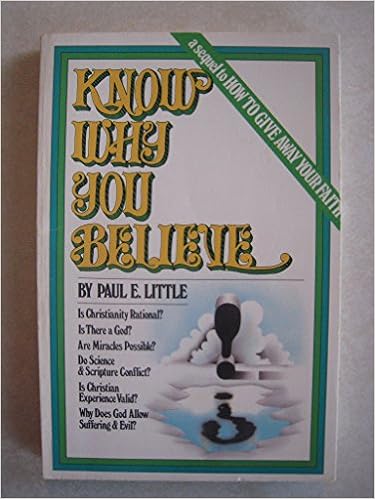
Book Review: Know Why You Believe by Paul E. Little

This review was originally posted on Goodreads.

Image Credit: Amazon. I actually read this 1968 version.

I read this book because it was on a "most influential books on evangelicals" list. I can see why it rightly was on that list. First, I'll briefly go over some positives; and then, some negatives.

"Are Miracles Possible?" was filled with tons of information that was new to me -- and the book is over 40 years old. This attests to either the author's creativity or to this reader's ignorance: I'd like to think it is the former.

The political scientists and analysts at the libertarian think-tank The Cato Institute often talk about the states (all 50 of them in the U.S.) as being "laboratories of democracy." Maryland has high taxes; Florida doesn't. New York has ridiculous rent control laws; other states don't. Through these legislative experiments we can see the effect on people. Some people move away from the states with high taxes, and so on.

In a passage Little briefly recalls atheist philosopher John Stuart Mill's view of divine justice via a quote from Hugh Evan Hopkins. If God were just, or if there was a thing as divine justice, then that justice would look like everyone getting their just reward according to their good deeds and bad deeds.

Little then says the most interesting thing to me in the book: "To see the logical consequences of Mill's "exact reward" concept of God in his dealings with man, we need only turn to Hinduism."

And by turning to Hinduism, and the lands effected by Hinduism, we are looking at "laboratories of theology." What are the results of this "exact reward" atheological experiment when the people believe that the god of the universe creates a system based on the thought of John Stuart Mill?

He continues: "The law of Karma says that all of the actions of life today are the result of the actions of a previous life. Blindness, poverty, hunger, physical deformity, outcastness, and other social agonies are all the outworking of punishment for evil deeds in a previous existence. It would follow that any attempt to alleviate such pain and misery would be an interference with the just ways of God. This concept is one reason why the Hindus did so little for so long for their unfortunates."

Then he presses in even more: "Some enlightened Hindus today are talking about and working toward social progress and change, but they have not yet reconciled this new concept with the clear, ancient doctrine of Karma, which is basic to Hindu thought and life."

In short, modern Hindus speak of reform.

But like with reforming Islam, to reform Hinduism its adherents would have to ignore their scripture.

At one point, in the lands given up this to religion, where one doesn't interfere with another person's karma, we saw people in poverty. Moreover, we also saw these countries taking a lot of time to catch up in wealth to Western countries. In contrast, in Christian U.S.A. we see all of the above social agonies being alleviated rapidly, because the Christian worldview allows for charity and entrepreneurship.

"Do Science and Scripture Conflict?" was golden, but it was not flawless. Little mentions certain presuppositions are necessary to science. This is good. However, the doesn't clamp down on the fact that only under the Christian worldview does science work.

Second, the chapter on archaeology and the Bible was a snooze. But I don't think I should be so crass as to say it was a worthless effort. There are people who attempt to discredit the Bible with archaeology, so it is only right that archaeology be covered.

To have written a book on apologetics 40+ years ago and still have insights that are fresh to a seasoned apologetics consumer (meaning I've watched a lot of debates and read a lot of articles on the subject) is an accomplishment.

Stylistically, this book was immensely quotable: I wanted to tweet every other paragraph. The book also simply ends. There is no final review of the cumulative case for Christianity or a concluding chapter.


I'd keep this book on the influential books list.

Monday, October 12, 2015

Libertarianism leads to anarchy

Libertarianism leads to anarchy. When I was a libertarian anarchist, a self-described "Christian Rothbardian," I thought that was a good thing.

I caught myself being contradictory

I caught myself being contradictory, so I deleted the following sentence out of a blog-in-process:
But being pro-peace means being anti-violence; and that includes violence from the state against individuals. You can't have a fully-orbed pro-peace philosophy if you are pro-violence somewhere down the line in your thinking.
This means I can never be fully libertarian in the Rothbardian sense of the word.

The truth is that I do believe in government force, but only where it is legitimate.

As one high-level person in the Libertarian Party once told me, under the Libertarian Party, 90 percent of government would shrink at all levels.

That's pretty much what biblical law would do as well.

Thursday, September 17, 2015

Can non-religious libertarians account for their libertarianism?

Please allow me to plagiarize myself without using quotation marks for a moment.

As I wrote in my last blog post, according to a poll on the Libertarian Party website, most self-identified libertarians in a recent poll are Christians.

Following Christians, the non-religious (including atheists and agnostics) make up the next largest group of liberty lovers.

In fact, those with no religion, which would include atheists and agnostics, accounted for 39 percent of those polled.

However, when you add Catholic, Baptists, Methodists, Lutherans, and "Other Christians" together, Christians collectively make up 46 percent of the poll.

Those who identified "Other Christian" made up 24 percent of the poll.

Muslims made up the smallest sliver of the poll, coming in at 1 percent.
This is all well and dandy. But the real question is can atheists and agnostics and other non-religious people account for their libertarianism?

Do non-religious libertarians have the proper foundations to ground their libertarianism?

Given their materialism, why should they be libertarians at all? On secular grounds, why should they be libertarians over Marxists? Is it all a matter of preference on the materialistic view?

The best essay that I have read that answers these questions is one I came across earlier this year by Gordan Runyan in his essay "God - the Only Ground for Freedom (or, Why Secular Libertarianism is a Bust)."

Here's a good summary paragraph from the essay:
As I have shown in my book, Resistance to Tyrants, it is only Christianity, with its special revelation, a full Bible breathed out by the one living God, that is capable of supplying the philosophical and moral foundations that will allow human freedom to weather the storms and remain standing. Christianity is the basis for genuine libertarianism. Atheistic libertarianism is the contradiction. It only ever gets anything right by stumbling into a biblical principle now and again. It is the proverbial blind squirrel that manages to accidentally find a few nuts. 
Read the rest.

Most Libertarians are Christians (or have no religion)

According to a poll on the Libertarian Party website, most self-identified libertarians in the poll are Christians. Following Christians, the non-religious (including atheists and agnostics) make up the next largest group of liberty lovers.
According to a recent poll that the author took part in, most self-identified libertarians who took the poll are Christians or have no religion.

In fact, those with no religion, which would include atheists and agnostics, accounted for 39 percent of those polled.

However, when you add Catholic, Baptists, Methodists, Lutherans, and "Other Christians" together, Christians collectively make up 46 percent of the poll.

Those who identified "Other Christian" made up 24 percent of the poll.

Muslims made up the smallest sliver of the poll, coming in at 1 percent.

Catholics made up the third largest portions of libertarians at 11 percent. And "Other non-Christian religions" and Baptists were almost matched at 6 percent and 5 percent respectively.

The wording of the poll was as follows: "I consider myself to be a Libertarian politically and the word that best describes my religion is."

It then gave the choice of what you see above.

18,906 had taken the poll at the time of the author's taking, which was around 8:00 p.m. on September 17, 2015.

It was located on the front page of the Libertarian Party website.

Editor's Note: The author is a Christian in the Orthodox Presbyterian Church, or the Reformed Tradition.

Saturday, April 25, 2015

Douglas Wilson on the Five Smooth Stones of Theocratic Libertarianism

Reformed writer Douglas Wilson proposes five things that must be done in order to reform the government and, by extension, American society. 

He stresses that liberty is a Christian value. Therefore, he wants liberty for secularists not because secularism is a good thing in itself; it isn't, even if some things within secularism are biblical and reflect the heart of the creator. I have always thought that if secularism is true, then it should be able to withstand free debate (no coercion). Truth wins out, right?


Note that the first stone is not the same as the fourth. Formally professing that Jesus Christ is Lord (the first stone) is not the same as fourth (allowing preachers to be free to preach the gospel).  But a formal declaring is necessary, he argues, and I agree.

Also, professing mere areas of agreement is not the same as establishing a national church. He wants none of the latter.

Here are some notable quotables:

If you protest that this would kill the great secular experiment that is America, I would reply that the great secular experiment that is America appears to have already gone out behind the barn and shot itself.

….we must have countless preachers of the gospel, faithfully declaring the death, burial and resurrection of Christ. The role of the government here is to stay out of the way, allowing such preachers free access to the people, and thereby encouraging them to have at it. 

There is a straight line blessing that runs from free grace to free men, and from free men to free markets.

Using their own money, voluntarily donated, the secularists and atheists may build their own schools, write poems and novels, produce plays and movies, build cathedrals, compose concertos, and so on.


Sunday, July 14, 2013

A Conservative Icon Wrote This? F.A. Hayek on Compulsory Health Care

Sounding like Newt Gingrich and Barack Obama wrapped in one, the conservative--not libertarian--intellectual Friedrich Hayek pretty much defends the Affordable Care Act, President Barack Obama's signature legislative "achievement" in the realm of health.

Via GaryNorth.com:
"There is little doubt that the growth of health insurance is a desirable development. And perhaps there is also a case for making it compulsory since many who could thus provide for themselves might otherwise become a public charge. But there are strong arguments against a single scheme for state insurance; there seems to be an overwhelming case against a free health service for all." -- F. A. Hayek.
Hayek wrote this on page 298 of his magnum opus, The Constitution of Liberty (1960). We could put this another way.
This isn't about putting government in charge of your health insurance; it's about putting you in charge of your health insurance. Under the reforms we seek, if you like your doctor, you can keep your doctor. If you like your health care plan, you can keep your health care plan.
These words may sound familiar. They are from President Obama's 2009 speech calling on Congress to pass ObamaCare.
And this little nugget from North (not Hayek) here:
HAYEK WAS A CONSERVATIVE, NOT A LIBERTARIAN

Hayek was much closer to conservatives than to libertarians. He was much closer to Russell Kirk than he was to Murray Rothbard. Neither Kirk nor Hayek believed in economic law. They both rejected the idea on the same basis, namely, their commitment to some form of social evolution. Each of them would come down on the side of free-market institutions, for they did not trust the operations of state bureaucracies, but always on the basis of a pragmatic argument that society had chosen these free market institutions voluntarily. Then the question arises: "How can we stop the state from invading and capturing the institutions of society?" Or this: "How can we stop the politicizing of social institutions by the state?" Hayek had no philosophical answer, and neither did Kirk.
 F.A. Hayek: Obamacare's Defender || GaryNorth

Monday, June 3, 2013

Antony Flew: Libertarian

Many Christians know of Antony Flew because he was an atheist and debated Christian apologist William Lane Craig and resurrection scholar Gary Habermas. But Flew was also a friend of liberty and an advocate for political and economic freedom.

Here are some of his writings in "The Freeman," a publication of the Foundation for Economic Education.

Wednesday, May 29, 2013

Henry Louis Gates, Jr. Says Ron Paul Is Right

So he didn't actually say that (via The Root). But what did happen was that he bolstered a point Ron Paul made almost a year ago:

Despite the gains of the abolition of slavery and the three Reconstruction amendments to the Constitution, Jim Crow segregation had pervaded every aspect of American society since the 1890s. And the military was no exception. When black men volunteered for duty or were drafted following the Japanese sneak attack, they were relegated to segregated divisions and combat support roles, such as cook, quartermaster and grave-digging duty. The military was as segregated as the Deep South.
Ron Paul on C-Span in 2012 (via Politic365):
“But when you look at the problems, the government is basically the problem, even with the racial problems,” Paul said on the Washington Journal.

“First it endorsed and legalized slavery. And then it comes along and it was the Jim Crow laws that provided the integration. Who was the biggest segregationist? It was our military up until after World War II.”

The claim that the U.S. Armed Services was the “biggest segregationist” was one that was generally correct, an expert told Politic365.com.

“Ron Paul is correct.  There was a policy of segregation in the U.S. Armed Forces during the Second World War,” said William Bundy, a professor at the U.S. Naval War College.  “However, that is only part of the story.”

“I would say to you that the matter of race in the military is kind of a long story that is not told very easily. And it really stretches back to the Revolutionary War to where we are today.”

Bundy, himself being the third African-American naval officer to command a submarine, said that military can be seeing as a reflection of society.

“Life for Blacks in the service has generally reflected the treatment of Blacks in the population of these United States,” he wrote in an e-mail.

While several ships were segregated in the Navy during World War II there were also Navy groups that started to integrate, he explained.

Bundy pointed to an article written by Morris J. MacGregor, Jr. for the U.S. Army Center of Military History which explained that Army policy during World War II was also a policy of segregation, and at times defended it in the name of “military efficiency.”

However, the Army was also the biggest employer of minorities during the Second World War.
Additionally, Bundy explained that black military achievement and advancement has existed throughout U.S. Armed Services history, pointing to The Red Tails, otherwise known as the Tuskegee Airmen serving in World War II, and the U.S.S. Mason, a naval warship with a predominantly African-American crew.

“However, it was Eleanor Roosevelt, President Harry Truman and others who lead change during and after the war over the objections of leaders who were wed to their times that embraced the separation of the races,” Bundy said, noting that Truman signed Executive Order 9981 which called for the desegregation of the military.

Wednesday, March 27, 2013

The Pro-Gay Marriage Reader - A Constitutional Perspective

The Constitutional Case for Same-Sex Marriage || UnitedLiberty.org

A strong argument that, while acknowledging that the libertarian notion that the best deal would be for the government to get out of the marriage business, also acknowledges the Jim Crow-like 2-tier marriage system is here and needs to be dealt with. Marriage for me, but not for thee, it argues, is not how things should be until the government gets completely out. Perhaps its most powerful argument, however, is that "[b]y outlawing same-sex marriage, the states are essentially forbidding religious institutions to marry whom they with."

The Moral and Constitutional Case for a Right to Gay Marriage || Cato.org

The Chairman of the libertarian-think tank the Cato Institute argues that "equal protection of the law" applies to homosexual/same-sex couples as well. Levy says that no compelling reason why the government sanctions marriage for heterosexuals and not for homosexuals has been given. Additionally, he argues that reasons to ban same-sex marriage - it would weaken the institution of marriage - isn't helped by that very ban, and offers legal suggestions to strengthen conservatives beloved institution.

The take-away from both articles:

The strongest case, it seems, for the pro-same-sex marriage crowd is to argue that banning gay marriage is a violation of the "equal protection of the law" granted in the 14th Amendment. Also, both writers are libertarians it seems they really wish - Levy uses the term "regrettably" - the government didn't get involved in marriage in the first place.

Bonus: Can We Really Get The Government Out of Marriage?

A piece giving a historical overview of the government's involvement in marriage, including property, taxes, and all sorts of benefits and protections, and acknowledges that "marriage licenses" are relatively new in human, or at least Western, history.

Bonus: When Did Laws Denying Same-Sex Couples Marriage Licenses Become Unconstitutional?

Another history lesson. This time, it answers when denying marriage licenses to gays became unconstitutional.

Friday, September 30, 2011

Video: Bill Buckley Jr on Drug Legalization

From Wikipedia:
George H. Nash, a historian of the modern American conservative movement, believed that Buckley was "arguably the most important public intellectual in the United States in the past half century... For an entire generation, he was the preeminent voice of American conservatism and its first great ecumenical figure."
So the man who defined modern conservatism was for the legalization of drugs? (And said George Bush wasn't a true conservative?)

Monday, May 30, 2011

Rothbard on the Libertarian Attitude Toward War

Excerpted from War, Peace and the State:
The libertarian's basic attitude toward war must then be: It is legitimate to use violence against criminals in defense of one's rights of person and property; it is completely impermissible to violate the rights of other innocent people. War, then, is only proper when the exercise of violence is rigorously limited to the individual criminals. We may judge for ourselves how many wars or conflicts in history have met this criterion.
Murray Rothbard, A Libertarian Theory of War

Monday, April 18, 2011

Featured on The #Libertarian Daily...again


I just found out that I was featured on The #Libertarian Daily...a day late. So I couldn't get the screen capture that I wanted and I had to use the search engine to find what article was featured.

As you can see above, my post about Murray Rothbard on the Clinton Administration was posted.

Thanks JP_O. Follow him on Twitter @JP_O.

Monday, March 28, 2011

Impeach Barack Obama? Why Not.

Several important figures in the libertarian movement have stepped in and opined on the President's justification of his sending the U.S. military to attack Libya. All these essays were written before tonight's speech. The third essay wasn't even written this year.

Here are three important essays:

1. Impeach Barack Obama by John Walsh
2. The Phony Arguments for Presidential War Powers by Thomas Woods
3. The Case for Impeachment of President Barack Obama by David Lindoff

Tuesday, March 15, 2011

Laurence Vance on Libertarianism's Compatibility With Christianity

Laurence Vance has done us the tremendous favor of making a case for Christianity and Libertarianism being compatible - a far greater job than I've seen anywhere else.

Here is an excerpt:
So, all that being said, my short answer to the question of whether libertarianism is compatible with is religion yes. But since it would not be enough just to say "I am religious, I am libertarian, so the answer to the question has to be yes, thank you and good day," my long answer is what follows.

He continues:
So, why do I think that religion – in this case the Christian religion – is compatible with libertarianism? Let me give you two verses of Scripture, one from the Old Testament and one from the New, since Christians accept the authority of both:

Proverbs 3:30 – "Strive not with a man without cause, if he have done thee no harm."

1 Peter 4:15 – "But let none of you suffer as a murderer, or as a thief, or as an evildoer, or as a busybody in other men’s matters."

These verses, my friends, embody the essence of libertarianism. Don’t kill anyone, don’t take what’s not yours, don’t do anyone wrong, don’t stick your nose in someone else’s business, and don’t bother anyone if he hasn’t bothered you.


Read the rest here: Is Libertarianism Compatible with Religion?

WCF Chapter One "Of Holy Scripture" Sunday School (Sept.-Oct. 2021)

Our text for Sunday School (also "The Confession of Faith and Catechisms") Biblical Theology Bites What is "Biblical Theology...