Showing posts with label Homeschool. Show all posts

Thursday, October 14, 2021

Someone gave me a nice compliment today


Someone gave me a really nice compliment today.

They said I would have really "deep-thinking children" that "won't take things at face value."

That's the plan man.

And that's why marrying the right woman is so important. The woman I choose has to be down with it. She cannot retard progress or be lazy. I screen for this in the dating process.

I don't want to raise humans with malformed minds. I do not trust private school or public school with my children's minds. We're going to educate them ourselves.

I estimate that I have around 1,000-2,000 books in my library. I've only read about 25-27 books this year. I'm really behind with my goal of 52 books in 2021 but more important things interrupted me. But I'm curating a list of books I want my family and friends to read -- books that should be read a least twice and internalized.

I want my children to be beneficiaries of my personal teaching and guidance and inherit my ever-growing library. 

She doesn't have to have my extraordinary reading goals. But one of the things she has to be about is educating our kids.

Book Recommendations**

  1. Biblical Theology: How the Church Faithfully Teaches the Gospel by Nick Roark & Robert Cline
  2. The Household and the War for The Cosmos by C.R. Wiley
  3. Sermon on the Mount by Scot McKnight
  4. The Case for Patriarchy by Timothy J. Gordon
  5. Living in a Godly Marriage by Joel R. Beeke
  6. Manifested in the Flesh by Joel McDurmon
  7. Sinful Speech by John Flavel
  8. Evangelism: How the Whole Church Speaks of Jesus by J. Mack Stiles
  9. A Christian's Pocket Guide to Loving the Old Testament by J. Alec Moyter
  10. The Nomadic Wealth Formula: A Blueprint for Generating Predictable and Sustainable Income from Anywhere on Earth by Jason Stapleton
  11. Man of the House by C.R. Wiley
  12. Thoughts on Family Worship by James Waddel Alexander
  13. How Should Men Lead Their Families by Joel R. Beeke
  14. The Case of the Hopeless Marriage: A Nouthetic Counseling Case from Beginning to End by Jay E. Adams
  15. Reforming Marriage by Douglas Wilson
  16. Economics in One Lesson by Henry Hazlitt
  17. The Politically Incorrect Guide to Capitalism by Robert P. Murphy
  18. Meltdown: A Free Market Look at Why the Stock Market Collapsed, the Economy Tanked, and Government Bailouts Will Make Things Worse by Thomas E. Woods
  19. End the Fed by Ron Paul
    **This list is in progress and mostly reflects my 2021 reading. The last four books I read in previous years.

    Wednesday, November 4, 2015

    The insufficiency of Sunday-only worship and schooling

    In his "State of the Church 2014" sermon, Douglas Wilson said "If you have sermonettes, you will have Christianettes." That is, if all you are getting is a 20 minute sermon a week, 20+ minutes of worship, you aren't really becoming a Christian. You're becoming a "Christianette."


    In the same sermon, he praised his church for being people who strive to be bible people -- a congregation that knows their bible. It's pleasing to a pastor when a pastor can dig deeper into the scriptures, Wilson said, rather than going over the elementary parts of the faith all over again.

    It's a great point.

    Back in 2010, Gary Demar noted something similar. He noted that humanists are happy that many Christians are only spending just a little bit of time in church and more time in secular public schools.

    He starts off the article like this:
    Many Christians claim a form of factual neutrality where some subjects (e.g., science, medicine, technology, geography, politics, mathematics) can be taught without any regard to religious presuppositions since “facts speak for themselves.” This is most evident in education where a self-conscious sacred-secular divide is maintained and supported by Christians. Ninety percent of Christian parents send their children to government schools. Since these parents believe that math is math and history is history, the religious stuff can be made up at church. But one hour of Sunday school and an hour at Youth Meeting each week and maybe a mission trip in the summer can’t make up for five days a week, six hours each day, 10 months of the year, 12+ years of a government-developed curriculum that is humanistic to the core.
    He then quotes a humanist publication from the 1930s to drive home the point. Demar writes:
    The humanists understand the importance of education in creating worldview shifts and control, so why don’t Christians? Charles Francis Potter, who founded the First Humanist Society of New York in 1929 and signed the first Humanist Manifesto in 1933, made no secret of the purpose of the American public schools:
    Education is thus a most powerful ally of Humanism, and every American public school is a school of Humanism. What can the theistic Sunday-school, meeting for an hour once a week, and teaching only a fraction of the children, do to stem the tide of a five-day program of humanistic teaching.


    Wednesday, September 7, 2011

    Gary North on Christian Education (In 1995)

    From a letter written to his ICE subscribers:
    What does your child really need?

    First, he must learn how to read early, so he will enjoy reading throughout his life. He must learn to read critically. This means he must also learn to write, for in writing, the student learns how others have communicated with him through the printed page. Reading and writing are complementary skills.

    Second, he should gain a knowledge of the Bible. I prefer the King James Version, for these reasons: (1) the language is magnificent; (2) its unique phrases stick in the mind, making Bible study easier; (3) the Strong's numbers are tied to the King James, making serious Bible study easier, especially with a modern computerized Bible search program.

    Third, he must master mathematics. Until there is a self-consciously Christian version of Saxon's math program available, we should go with Saxon, which emphasizes review and mastery. Fourth, anything else that interests him. Let him master a subject for the joy and experience of mastering it.

    Christian education should be highly focused on a handful of topics: reading-writing, Bible, and mathematics. To force a child to take six courses per semester is both traditional and foolish if the child has not first mastered reading, writing, arithmetic, and the Bible. If he has mastered these, he can pick up the other courses in short order, such as by preparing through Advanced Placement exam cram courses.
    Read the rest by clicking here.

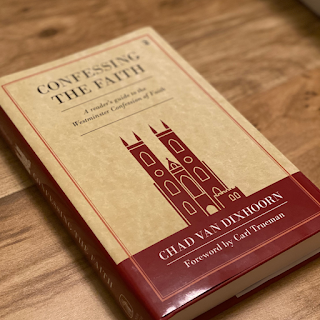
    WCF Chapter One "Of Holy Scripture" Sunday School (Sept.-Oct. 2021)

    Our text for Sunday School (also "The Confession of Faith and Catechisms") Biblical Theology Bites What is "Biblical Theology...