Showing posts with label Free-Markets. Show all posts

Monday, September 21, 2015

On Free Water, Free Tuition, Free Healthcare, Bernie Sanders, and Rand Paul

I was at an event last night and a speaker said something to the effect of "Only in America" -- or let's say under capitalism -- do they make you pay for something free like water, as she sipped her bottled water... 

… bottled water that has been contained with machinery, filtered, and bottled -- among a host of other things -- by human beings.

…bottled water that was at one time in a river, or lake, or mountain, or spring, or wherever they get water from (the beauty of the division of labor in free-market capitalism is that I don't have to know that stuff).

In part, she wanted specialized knowledge to be free.

Deer Park employees, among the many other water companies' employees, are people who wake up every day provide a vital product to the billions of people who chose not to be in the water business. Numbers of trucks which run on un-free gasoline deliver this vital source for life every single day to the market place.

Gone are the days of carrying a pail of water to the river, scooping up as much water as you can, and carrying it back to the hut village. Gone are the days of getting water from the well.

The water companies have gotten so good at this that they provide water in different sizes -- from little bottles that can fit in your palm, to bigger bottles that be put on water coolers; these bottles come in size swig, saturate, and submerge. Gone are the days of size pail and bucket.

They have gotten so good at it that water comes with flavor.

And yet they want this to be free.

Fine, I'll grant you, but only for the sake of the argument, that water is free. What I won't grant you is that the labor should be free. Further, I know that you won't either.

Much of that was my immediate thought but I didn't say anything. It wasn't the right forum. It would have taken the event over the allotted time. The only thing I thought in addition to that is that working for free involuntarily is what we used to call slavery. 

But I know what they mean: Whether it is free school or free water, advocates will say workers will get paid through taxes. But that only pushes the involuntary labor to the taxpayers.

Why should I involuntarily use my labor to pay for someone else's stuff?

That is an ethical problem for Democratic Socialists.

But I want to put another thorn in the side of Democratic Socialists.

Going back to the subject of water companies, why should someone like Coca-Cola, the Dasani water owners, be mandated by the government to operate a large part of their company for F-R-E-E.

Am I shifting definitions? Don't I know that Democratic Socialists would, through taxpayer dollars, pay a company to operate their water business.

Oh, so you want to get into subsidizing big businesses and corporations. Gee, I thought that was what you were protesting in the first place.

But let's take it one step further. Why should we think of only existing businesses as free providers of this vital product? Why not apply our thinking to future entrepreneurs? The little guy. Should the little guy provide this service F-R-E-E?

Should we subsidize the little guys future water business? Should he not operate by profit-and-loss to judge the success of his business?


Rand Paul had a similar experience.

He was asked a question about Bernie Sanders' solution to Social Security.

I like Rand Paul's answer. He admits up front that you are not going to like his solution. Furthermore, he gives the alternative: He can pretend like everything is okay and promise you everything you want and destroy the country in the process.

By destroying the country, he probably means destroying our dollar through hyperinflation. The Federal Reserve would have to create so much money that our dollar would become worthless.

Democratic socialists, like Bernie Sanders, would solidify our economic doom.

[Editor's Note: Regular readers of this blog should know that I was coming up with a "Why You Should Not Vote For Bernie Sanders" series. 
The reason I am doing this is because a number of my (young) friends are falling for the rhetoric and promise of Democratic Socialism. It (often rightly) rails against big business.  It (almost) never rails against the government framework which made big business possible. 
It is embodied in the persons of Elizabeth Warren and Bernie Sanders. Unfortunately, they're both wrong.
My posts will be informed by the Thomas Woods' new E-book Bernie Sanders is Wrong, other informed economic articles, and my personal reflection, as was the case with the first post above.
This is Part 1 of many…and I mean many.]

Saturday, April 25, 2015

Douglas Wilson on the Five Smooth Stones of Theocratic Libertarianism

Reformed writer Douglas Wilson proposes five things that must be done in order to reform the government and, by extension, American society. 

He stresses that liberty is a Christian value. Therefore, he wants liberty for secularists not because secularism is a good thing in itself; it isn't, even if some things within secularism are biblical and reflect the heart of the creator. I have always thought that if secularism is true, then it should be able to withstand free debate (no coercion). Truth wins out, right?


Note that the first stone is not the same as the fourth. Formally professing that Jesus Christ is Lord (the first stone) is not the same as fourth (allowing preachers to be free to preach the gospel).  But a formal declaring is necessary, he argues, and I agree.

Also, professing mere areas of agreement is not the same as establishing a national church. He wants none of the latter.

Here are some notable quotables:

If you protest that this would kill the great secular experiment that is America, I would reply that the great secular experiment that is America appears to have already gone out behind the barn and shot itself.

….we must have countless preachers of the gospel, faithfully declaring the death, burial and resurrection of Christ. The role of the government here is to stay out of the way, allowing such preachers free access to the people, and thereby encouraging them to have at it. 

There is a straight line blessing that runs from free grace to free men, and from free men to free markets.

Using their own money, voluntarily donated, the secularists and atheists may build their own schools, write poems and novels, produce plays and movies, build cathedrals, compose concertos, and so on.


Thursday, March 12, 2015

Saturday, February 22, 2014

Vladimir Putin learns the wrong lesson from the Soviet Union's collapse

As I was watching the opening ceremony for the 2014 Winter Olympics in Sochi, a commentator said that Vladimir Putin thought the collapse and break-up of the Soviet Union was devastating, or something to that effect, and that Russia lost a lot of "good Russians." 

Bizarreness of that statement put aside, it deflects from real analysis of the Soviet Union's collapse in 1991.

What we should make of the Soviet Union's collapse was that we saw the complete and utter collapse of a nation based on an idea: Socialism. 

The "former glory of the Soviet Union" was no glory at all because socialism -- no matter how many years and decades it will take -- always plants the seeds for economic destruction. So going back to it would be like a "dog going back to its vomit" (Proverbs 26:11), and fool repeating his folly.

One other point here.

We are not unlike the Soviet Union.

As Thomas Woods explained in his 2009 book "Meltdown": "[the U.S. Federal Reserve System] is dedicated to central economic planning, the great discredited idea of the twentieth century. Except instead of planning the production of steel and concrete, as in the Old Soviet Union, it plans money and interest rates, with consequences that necessarily reverberate throughout the economy."

We are in the midst of a grand experiment that will end in nothing less than devastation for a lot of people. As I explained in previous statuses**, the time for a "soft landing" was over a decade ago. We should end our foolishness now to avoid an even harder landing later.

**Originally written as a Facebook status

Saturday, January 11, 2014

On the apologetic abilities of ex-believers

“Bart Ehrman’s career is testament to the fact that no one can slice and dice a belief system more surgically than someone who grew up inside it.” —Salon.com via New Testament scholar Bart Ehrman's old website.

There is a lot of truth to this maxim; but its applicability, as it suggests, extends far beyond just ex-Christians like Ehrman. It even extends beyond religion.


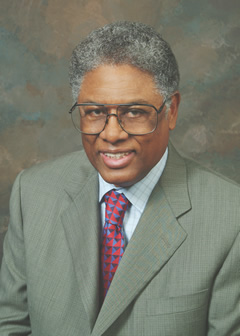
Thomas Sowell, for example, was a marxist that didn't come around to free-markets until he saw his god, his economic religious system, his beliefs he was immersed in, fail. This happened while he was interning for the U.S. federal government in the Department of Labor (I think).

He now is, as he has been for decades, dismantling the left-wing worldview in his weekly columns and books.

American humorist P.J. O' Rourke was also a man of the left, until he got a job, he's quipped a few times.

Christopher Hitchens, whom I will mention again below, was once a committed Trotskyist and socialist in the 1970s and 80s and later came to embrace, well, something.

It's not clear that he is writing approvingly, but in the foreword to Choice: The Best of Reason, Hitchens writes:
But the subsequent industrial and technological revolutions have displaced a good deal of power and initiative away from states and corporations--and the unspoken alliance between them--and toward the individual worker and producer. More than this, they have greatly attenuated the frontiers of states and nations and made it easier to be an everyday "internationalist" than many once-leftist parties would have believed possible. [1]
At the very bottom, this is a major admission of the success of capitalism from a former socialist.

Ex-Christians turned atheists, Ex-atheists turned Christians

There are also many ex-atheists who spend much of their life dedicated to sharing the gospel of Jesus and God's coming kingdom to unbelievers. C.S. Lewis, whom I've never actually read yet, except for that liar, lunatic, or Lord line,* comes to mind (I don't think that's too much of a simplification of my past).

Lewis, went on to write many books defending Christianity, such as Mere Christianity, and creatively shared the Christian worldview in his works of fiction, the most notable probably being the Chronicles of Narnia series. (I hear the space trilogy series is pretty good too.)


Some less prominent examples such as David Wood and  former Ex-Atheist.com proprietor A.S.A. Jones; others include Peter Hitchens, Alister McGrath, Francis Collins, John Harwick Montgomery, Marvin Olasky, and novelist A.N. Wilson.


Heck, even the late philosopher Antony Flew, who did not become a Christian his last years, became a deist (his words), and put out a book about how he believes in God, albeit a sort of "Aristotelean god."

Richard Dawkins and the late Christopher Hitchens and are on the opposite end of the spectrum. Dawkins admitted to losing his "last vestiges of religious faith" (if I can recall that correctly from The God Delusion Debate DVD with John Lennox) in his teenage years; Hitchens, in his adolescence (around 9).


Dawkins was actually very explicit about why he believed as a young Christian. Via Wikipedia:
"the main residual reason why I was religious was from being so impressed with the complexity of life and feeling that it had to have a designer, and I think it was when I realised that Darwinism was a far superior explanation that pulled the rug out from under the argument of design. And that left me with nothing."
And then, he spends his entire life not striding against religion -- no, that came in recent years -- but in the scientific field explaining the Darwinian origins of life; fleshing out that theory, defending that theory, and re-telling the gospel of Darwin for each generation anew with such works as The Selfish Gene (1976), The Extended Phenotype (1982), The Blind Watchmaker: Why The Evidence of Evolution Reveals A Universe Without Design (1986),  River Out of Eden, (1995) Climbing Mount Improbable (1996), Unweaving the Rainbow (1998), The Ancestor's Tale (2004), The Greatest Show on Earth: The Evidence for Evolution (2009), and The Magic of Reality: How We Know What's Really True (2011), never letting the gospel get stale.

In other words, he spent his career "surgically" explaining away design -- the very thing he used to believe in.

And if you were wondering why I described Dawkin's work as gospel, it's because I just saw the video below. N.T. Wright, in his own right, is a master at explaining the gospel to new generations of Christians. Pick up his "For Everyone" series to see what I mean.


[Editor's Update January 13, 2013 7:30 PM] It's somewhat of a genetic fallacy to say that because someone is an ex-believer in some religious belief or some economic philosophy, such as those mentioned above, that their new beliefs are true. However, the fact that they did leave one faith and now believe in something else should raise some eyebrows. 

*I know Lewis is not actually quoted in that link. However, I decided to link to perhaps one of the first websites that introduced that line of argument to me;  The Case For Christ DVD possibly being the other source for me.

Wikipedia has the quote in it's entirety and actually much to say about it from many sides.

[1] Gillespie, Nick. "Foreword." Foreword. Choice: The Best of Reason. Dallas: BenBella, 2004. 4.

Thursday, January 12, 2012

What is the market economy? (Part Two)

Mises answers again in Human Action:
The market is not a place, a thing, or a collective entity. The market is a process, actuated by the interplay of the actions of the various individuals cooperating under the division of labor. The forces determining the — continually changing — state of the market are the value judgments of these individuals and their actions as directed by these value judgments. The state of the market at any instant is the price structure, i.e., the totality of the exchange ratios as established by the interaction of those eager to buy and those eager to sell. There is nothing inhuman or mystical with regard to the market. The market process is entirely a resultant of human actions. Every market phenomenon can be traced back to definite choices of the members of the market society.
Ludwig Von Mises quoted in Mises on Money

What is the market economy? (Part One)

Mises answers in Human Action:
The market economy is the social system of the division of labor under private ownership of the means of production. Everybody acts on his own behalf; but everybody's actions aim at the satisfaction of other people's needs as well as at the satisfaction of his own. Everybody in acting serves his fellow citizens. Everybody, on the other hand, is served by his fellow citizens. Everybody is both a means and an end in himself, an ultimate end for himself and a means to other people in their endeavors to attain their own ends.
Ludwig Von Mises quoted in Mises on Money

Thursday, April 28, 2011

Ron Paul: FED Action's have "nothing to do with free markets"


Dr. Paul on the latest act of "transparency" by the Federal Reserve:
Without the Federal Reserve's relentless expansion of credit throughout the 1990s and early 2000s, there could have been no excessive borrowing or explosion of subprime lending. Through easy credit, the Fed initiated the economic boom that created the dot-com bubble. When that bubble burst the Fed pumped additional liquidity into the system, which led to a new boom that created the housing bubble. Commodity prices have risen rapidly, producer prices have followed suit and consumers are already seeing the beginning of massive price increases passed on to them. And now the Fed's additional trillions of dollars in monetary pumping is creating yet another bubble. This is the exact opposite of stability in the marketplace and has nothing to do with free markets. It is central economic planning at its worst. And the end result may be hyperinflation and the destruction of our currency.
Paul's statement on the Federal Reserve Conference

Tuesday, December 14, 2010

Our Student Loan Addiction

This image was taken from the Ripon College's Scholarships and Financial Aid page.

While Federal Grants are at 26 percent and state/local grants are at 40 percent, the amount of freshmen holding student loans is a staggering 80 percent at this college.

What bothers me so much about this statistic is that colleges can keep the price of tuition higher than what it would have possibly been if the student loans weren't there in the first place.

University planners, knowing that financial aid is guaranteed, plan expansion based on somewhat false signals in the markets (federal grants, student loans). It does not matter how big or small the false signal. They can be lilliputian or large. As long as their is some sort of intervention, there is always going to be some level of malinvestment on behalf of the university because the distortions give a false signal that savings for colleges are there even when they are not. Eventually, the number of students able to pay for college will shrink once the price of tuition becomes too high and the true number of adequate savers will be revealed.

Even the adequate savers get punished because they, too, pay an artificially high tuition price.

Budget cuts
, department cuts, tuition hikes, and major cuts will ensue as a result of decreased revenues. However, they would not have to happen, or at least be as severe, I think, if the distortion were absent and university accountants were allowed to plan growth within budget and naturally.

Saturday, November 6, 2010

The Necessity of Public Support of Free-Markets

Excerpted from the Mises Review of Meltdown: A Free-Market Look at Why the Stock Market Collapsed, the Economy Tanked, and Government Bailouts Will Make Things Worse:

"If the public does not understand the economics of depression, there is little hope that we can avoid disastrous government policies. Unless the free market receives sufficient popular support, our economic future is bleak." David Gordon

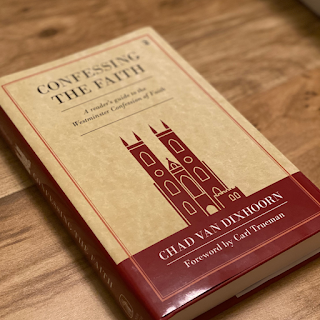
WCF Chapter One "Of Holy Scripture" Sunday School (Sept.-Oct. 2021)

Our text for Sunday School (also "The Confession of Faith and Catechisms") Biblical Theology Bites What is "Biblical Theology...