Starting today, the blog description is no longer "Educating Christians about The Currency Crisis - and Other Worldview Issues."
Instead, it is "Politics + Poetry + Philosophy."
Showing posts with label Philosophy. Show all posts
Showing posts with label Philosophy. Show all posts
Thursday, April 16, 2015


Sunday, June 8, 2014
Kreeft on the link between faith and humility
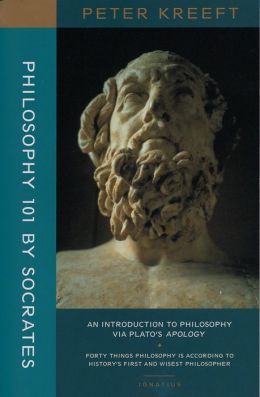
These two things naturally go together: belief in God and humility. These two things also naturally go together: skepticism about God and pride. For if there is no God, then man is the highest and wisest of all beings. But if there is a God or gods, then human wisdom, now judged by a higher standard, is relatively tiny. However proud and arrogant some religious believers may have been, humility is inherent in the very logic of religious belief. And however humble some unbelievers may have been, lack of humility is inherent in the very logic of unbelief.
No one saw this connection between humility (before truth) and belief (in God) more clearly than philosophy's most passionate atheist, Nietzsche. If there is no God, no eternal mind, he reasoned, then there is no eternal truth. Truth is only God without a face. Nietzsche dared to ask "the most dangerous question … why truth? Why not rather untruth?"~Peter Kreeft, Philosophy 101 By Socrates: An Introduction to Philosophy Via Plato's Apology (Forty Things Philosophy is According to History's First and Wisest Philosopher)
Book Review Forthcoming. Check back here in a week or two for a link.
Tuesday, April 22, 2014
Catholic philosopher Peter Kreeft on Pilate, Jesus' Epistemology
THE FIRST GREAT PHILOSOPHICAL question is: What is? The second, which naturally follows, is: How do we know what is? The first question is about being, the second is about truth.
Truth is relative to being, for “truth” means“the truth about being.” “An orange is round” is true only because an orange is round.
Jesus’ answer to the first question, the question of being, was Himself. It was not to point but to be, to be “I AM.” So His answer to the second question, the question of truth, is also not to point to anything else as the truth but simply to be Himself the truth: “I AM the truth.” ( John 14:6)
Thus the supreme irony of Pilate cynically addressing the philosophers’ great question “What is truth?” to the eternal, perfect, absolute, divine, eternal truth Himself, made incarnate and concrete and personal and standing before him, condemned.
Pilate’s skepticism implicitly complains: “How am I supposed to know that great philosophical will-o-the-wisp, ‘truth’? Can I see it? Can I touch it?” And Jesus answers: “Yes. In fact, you can crucify it.”
Peter Kreeft, Philosophy of Jesus (pages 47-48)
Sunday, February 23, 2014
Video: The Thomist Cosmological Argument (Peter Kreeft)
Catholic philosopher Peter Kreeft explains the Thomistic cosmological argument. I feel like I'm back in Philosophy of Religion with Van Fleteren again.
Thursday, October 31, 2013
David Berlinksi on the Old Testament
I would suggest to any student entering college now, 2011, to do what I'm sure he hasn't done: go read the Old Testament. That should be your first challenge today. I always ask my students "Well, have you (ever) read the, have you read the Bible? Yea, Yea, I read the Bible, sure. But when I interrogate the student it turns up reading the Bible means they have a Bible on their book shelf. And I said, "have you opened it?""Yea, we've opened it," but opening it doesn't mean reading it.
The Old Testament is the greatest repository of human knowledge and wisdom in the history of civilization, any culture, any time, any place. And that really should be the first point of discussion because every attitude current today in the discussion from Richard Dawkins, to me, to Christopher Hitchens, to lonely pastors in the Bible Belt on Sunday morning ranting from a particular text is discussed in the Bible, and there's a characters in the Bible who expresses that point of view, there's sympathy expressed for that point of view, and there's reservations expressed by that sympathy. It's an enormously complex, rich dramatic piece of work. That's the first.David Berlinksi on Uncommon Knowledge
Sunday, July 14, 2013
A Conservative Icon Wrote This? F.A. Hayek on Compulsory Health Care
Sounding like Newt Gingrich and Barack Obama wrapped in one, the conservative--not libertarian--intellectual Friedrich Hayek pretty much defends the Affordable Care Act, President Barack Obama's signature legislative "achievement" in the realm of health.
Via GaryNorth.com:
Via GaryNorth.com:
And this little nugget from North (not Hayek) here:"There is little doubt that the growth of health insurance is a desirable development. And perhaps there is also a case for making it compulsory since many who could thus provide for themselves might otherwise become a public charge. But there are strong arguments against a single scheme for state insurance; there seems to be an overwhelming case against a free health service for all." -- F. A. Hayek.Hayek wrote this on page 298 of his magnum opus, The Constitution of Liberty (1960). We could put this another way.
This isn't about putting government in charge of your health insurance; it's about putting you in charge of your health insurance. Under the reforms we seek, if you like your doctor, you can keep your doctor. If you like your health care plan, you can keep your health care plan.These words may sound familiar. They are from President Obama's 2009 speech calling on Congress to pass ObamaCare.
HAYEK WAS A CONSERVATIVE, NOT A LIBERTARIANF.A. Hayek: Obamacare's Defender || GaryNorth
Hayek was much closer to conservatives than to libertarians. He was much closer to Russell Kirk than he was to Murray Rothbard. Neither Kirk nor Hayek believed in economic law. They both rejected the idea on the same basis, namely, their commitment to some form of social evolution. Each of them would come down on the side of free-market institutions, for they did not trust the operations of state bureaucracies, but always on the basis of a pragmatic argument that society had chosen these free market institutions voluntarily. Then the question arises: "How can we stop the state from invading and capturing the institutions of society?" Or this: "How can we stop the politicizing of social institutions by the state?" Hayek had no philosophical answer, and neither did Kirk.
Subscribe to:
Comments (Atom)
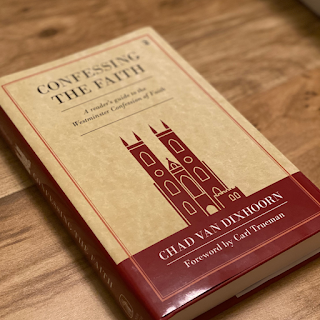
WCF Chapter One "Of Holy Scripture" Sunday School (Sept.-Oct. 2021)
Our text for Sunday School (also "The Confession of Faith and Catechisms") Biblical Theology Bites What is "Biblical Theology...
-
January 12, 2012 Update: The old link no longer works. The old link is still below but the new leak is right below the old link. Thanks to t...
-
 Our text for Sunday School (also "The Confession of Faith and Catechisms") Biblical Theology Bites What is "Biblical Theology...
