Austrian this, Keynesian that. Why should one embrace one over the other?
Kevin Swanson doesn't get into that, but he does say that our practical atheism is the reason why America is doing so badly nowadays.
Listen below.
It's true that Austrian economics is more in line with the biblical worldview, but what authority do Austrian economists stand on?
Mises and Rothbard.
In other words, men.
In the same vein, we have also embraced man's erroneous views of laws and economics -- that is why we will be in a depression.
Showing posts with label atheism. Show all posts
Showing posts with label atheism. Show all posts
Monday, September 28, 2015


Thursday, September 17, 2015
Can non-religious libertarians account for their libertarianism?

As I wrote in my last blog post, according to a poll on the Libertarian Party website, most self-identified libertarians in a recent poll are Christians.
Following Christians, the non-religious (including atheists and agnostics) make up the next largest group of liberty lovers.
In fact, those with no religion, which would include atheists and agnostics, accounted for 39 percent of those polled.This is all well and dandy. But the real question is can atheists and agnostics and other non-religious people account for their libertarianism?
However, when you add Catholic, Baptists, Methodists, Lutherans, and "Other Christians" together, Christians collectively make up 46 percent of the poll.
Those who identified "Other Christian" made up 24 percent of the poll.
Muslims made up the smallest sliver of the poll, coming in at 1 percent.
Do non-religious libertarians have the proper foundations to ground their libertarianism?
Given their materialism, why should they be libertarians at all? On secular grounds, why should they be libertarians over Marxists? Is it all a matter of preference on the materialistic view?
The best essay that I have read that answers these questions is one I came across earlier this year by Gordan Runyan in his essay "God - the Only Ground for Freedom (or, Why Secular Libertarianism is a Bust)."
Here's a good summary paragraph from the essay:
As I have shown in my book, Resistance to Tyrants, it is only Christianity, with its special revelation, a full Bible breathed out by the one living God, that is capable of supplying the philosophical and moral foundations that will allow human freedom to weather the storms and remain standing. Christianity is the basis for genuine libertarianism. Atheistic libertarianism is the contradiction. It only ever gets anything right by stumbling into a biblical principle now and again. It is the proverbial blind squirrel that manages to accidentally find a few nuts.Read the rest.
Wednesday, September 2, 2015
Christians act worse than non-Christians: Bible Edition
"But she [Israel, God's Holy People] has rebelled against my ordinances and statutes, becoming more wicked than the nations and the countries around her, rejecting my ordinances and not following my statutes." ~Ezekiel 5:6 (NRSV)
So basically God anticipated the whole "Christians act morally worse than non-Christians" argument 2,500 years ago.
In other words, it is a given in biblical thought that religious people can indeed act more wicked than those who don't follow that religion...but notice what standard is presupposed.
Sunday, October 26, 2014
Sermon Notes: Functional Atheism -- not atheism proper -- is what Psalm 53 is all about
The sermon's text Psalm 53:1-6 (NRSV).
Fools say in their hearts, “There is no God.” They are corrupt, they commit abominable acts; there is no one who does good.God looks down from heaven on humankind to see if there are any who are wise, who seek after God.They have all fallen away, they are all alike perverse; there is no one who does good, no, not one.Have they no knowledge, those evildoers, who eat up my people as they eat bread, and do not call upon God?There they shall be in great terror, in terror such as has not been. For God will scatter the bones of the ungodly; they will be put to shame, for God has rejected them.O that deliverance for Israel would come from Zion! When God restores the fortunes of his people, Jacob will rejoice; Israel will be glad.
- This text is not about atheism proper i.e. what Richard Dawkins spends time thinking about and what Christian apologists think about refuting; rather, it is about functional atheism.
- Functional atheism says "omniscience [God] does not see sin."
- Every sin presupposes a functional atheism.
- Paul quotes Psalm 53 in his indictment of the whole human race. Paul's point was that Jews and Gentiles are estranged from God.
- "Not the village atheist, and not the village priest" does good (Psalm 53:1).
- Functional atheists end up hating the people of God (Psalm 53:4).
- "Atheists devour ex-atheists," that is, atheists in the functional sense, which would include atheists proper.
- Atheists proper are very tiny in proportion to functional atheists.
- Living in sin is living with functional atheism.
- Sins happens in the presence of God.
- Sin is always personal with God.
- The atheist -- the unrepentant sinner -- would kill God if he could. The incarnation, when God took on human flesh in the person of Jesus Christ, made that possible.
- This [our murder of him] revealed our nature, and it revealed God's loving nature.
- "Salvation Grace is shaped like God."
- Yes, there should be a difference in the lives of believers and non-believers, functional atheists and functional believers, but the difference is in knowing what God is like.
- We should confess our sins because we messed up our relationship God -- not because we messed up our slate of good deeds that we wanted to perfectly present to God on the Day of Judgment.
Sunday, August 3, 2014
Tuesday, April 22, 2014
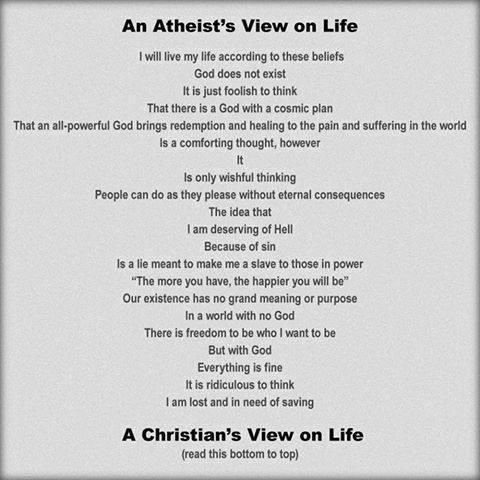
A not-so-hard question to answer from one atheist blogger
At Patheos, James Croft wrote some years back, recalling a live lecture (2012) on miracles from Ph.D. mathematician and Christian apologist John Lennox:
The Q&A was brief, but I’m glad my question was chosen to be asked: “ If I was to tell you I were just raised from the dead, what evidence would you require to believe it?”
I ask this question of all apologists for Christianity, because it goes right to the heart of the evidentiary claim: what would it take to convince them that someone they encountered today had indeed risen from the dead? There are two common responses: either apologists evade the question, or answer with standards of evidence way higher than the standards of evidence they use when considering the resurrection of Christ.Apparently, if you go to read on, Dr. Lennox had trouble answering this question. So I'll take this one.
Prove you were dead.
What could they possibly say in response?
Perhaps around before the publication of atheist philosopher Peter Boghossian's book "A Manual For Creating Atheists," and certainly codified in it, is the notion that Christians will evaluate a piece of evidence against Christianity very critically, so much more than they would examine any other piece of evidence for the veracity of their faith.
In their experience, Christians have had abominably lopsided approaches to evaluating evidence ("A false balance is an abomination to the Lord" Proverbs 11:1; "Do not use dishonest standards when measuring length, strength, or quantity" Lev. 19:35; "Do not have differing weights in your bag--one heavy, one light" Deut. 25:13).
This is, apparently, a common sticking point that atheists have in conversations with Christians, and is fashionable to regurgitate in talks online discussing the alleged implausibility of the Christian faith.
And if John Lennox couldn't answer this simple question, as was reported in the rest of the post that I didn't quote, I submit he was thinking too hard, and sticking too closely to his talking points. And if other Christians haven't been able to answer this question, I submit Christians need a lot more training in critical thinking.
Putting the onus of proof on himself
So again, prove you were dead.
His question puts all of the weight on the resurrection part. But his question hasn't even got off the ground yet, and may not ever.
He forgot somebody actually had to die to get there first. And apparently, he forgot he'd also had to prove that his lifeless corpse would have had to have to undergo a certain scientific examination itself -- and then be pronounced dead by the authorities. His metaphorical "tomb" would have to been made known to some folk, which was exactly was known of Jesus's tomb, before he met back up with his disciples to talk about the resurrection that just happened.
I mean, it's a common Christian retort that is beyond cliche territory, but, I mean, you know, he wouldn't want us to take the premise of his question on faith now would he?
And for all of his appeal to our modern sensibilities, you would have at least thought he would have been kind enough to provide his I.D. and death certificate so we could verify. There was no mention of those credentials in his blog.
In the gospel of John, we have a real doubting Thomas who asks a similar question.
“Unless I see the mark of the nails in his hands, and put my finger in the mark of the nails and my hand in his side, I will not believe.” A week later his disciples were again in the house, and Thomas was with them. Although the doors were shut, Jesus came and stood among them and said, “Peace be with you.” Then he said to Thomas, “Put your finger here and see my hands. Reach out your hand and put it in my side. Do not doubt but believe.” Thomas answered him, “My Lord and my God!” Jesus said to him, “Have you believed because you have seen me? Blessed are those who have not seen and yet have come to believe.” (John 20:25-29 NRSV)
Thomas asked. Thomas received. And this is of course recalled in one of four death certificates, I mean gospels, of Jesus' life. These are the death certificates we show non-believers all the time, and the I.D. where we can read about the life of our Lord, but with much more detail than a 2.5 x 4 I.D card.
Part of the problem with presumptuous, sloppy, and snobbish questions is that they assume too much and prove too little, if anything.
And that is where he went wrong. At least, if you believe in the historical Jesus you would believe that he died by crucifixion and was buried in the tomb of Joseph of Arimathea. Unless, of course, you are one of those types that believes he died and was buried in a shallow pit to be eaten by dogs (bad), or you don't believe in Jesus existed at all (worst).
Christians have a testimony grounded in history, four separate documents from four separate authors that attest to Jesus' crucifixion, on top of multiple ancient authors to attest to his crucifixion and burial.
This guy has a question backed with the conceit of a college sophomore.
The Close of the Atheist Witness
Reframing the question, if done in a way that oversimplifies the question, looses a few key premises, and then answers a straw man, is definitely unfair, and an abomination unto the Lord, and violates doing unto others as we would have done unto us.
But I do believe the blogger asked a question that needs some work [1]. I do think the question misunderstands some things about resurrections. I know a person who was legally dead (heart stopped) and then was resuscitated by doctors, which is what many of the "resurrections" in the New Testament are like. They are brought back to life to die again. But Jesus is the "first fruits," that is, the first of the resurrection unto immortality. And by definition, this 21st century man claiming to be resurrected can't be. The dead will be raised; flesh will put on immortality; corruption will put on incorruption (1 Corinthians 15:52-54), and all of this will happen at the "Last Trump" (v.52), not right before a Q&A at a John Lennox lecture.
For as in Adam all die, so also in Christ all will be made alive. But each in his own order: Christ the first fruits, after that (Who?) those who are Christ's at (When?) His coming, then comes the end, when He hands over the kingdom to the God and Father, when He has abolished all rule and all authority and power.… (1 Corinthians 5:22-24) [emphasis mine]
Apart from scripture and revelation, which, if true, is intimately linked to past, present, and future history, his question doesn't make any sense. Indeed, his claim to have been resurrected would mean that God is a liar that didn't keep his promise to raise the saints of God on the "Last Day." And that, personally, would raise my eyebrows indeed and warrant my scrutiny.
Indeed, his question can't even make sense in a world where atheism is true because by definition there would be no God to raise him.
On the apologetic method, I didn't even have to worry about who raised you or when were you raised or even begin to answer the question. I just made a simple demand: just prove you were dead. And then after that, prove your theology.
Like the question "Who Made God?" this question, like the former, as John Lennox put that one, is in schoolboy category, because, like how atheists misunderstand the nature of God, this question fundamentally misunderstands the nature of the resurrection.
And according to scripture, I would simply be able to look at him in his glorified body to see if he was resurrected. So would Lennox.
- I do think if he reduced his question to the point of simple "miracles" he would have a stronger case. But choosing the specific term "resurrection" he did not. For example, if he reframed it as "If I was to tell you that God performed a miracle in my life, what evidence would you require to believe it?"
Monday, January 27, 2014
Thursday, October 31, 2013
David Berlinksi on the Old Testament
I would suggest to any student entering college now, 2011, to do what I'm sure he hasn't done: go read the Old Testament. That should be your first challenge today. I always ask my students "Well, have you (ever) read the, have you read the Bible? Yea, Yea, I read the Bible, sure. But when I interrogate the student it turns up reading the Bible means they have a Bible on their book shelf. And I said, "have you opened it?""Yea, we've opened it," but opening it doesn't mean reading it.
The Old Testament is the greatest repository of human knowledge and wisdom in the history of civilization, any culture, any time, any place. And that really should be the first point of discussion because every attitude current today in the discussion from Richard Dawkins, to me, to Christopher Hitchens, to lonely pastors in the Bible Belt on Sunday morning ranting from a particular text is discussed in the Bible, and there's a characters in the Bible who expresses that point of view, there's sympathy expressed for that point of view, and there's reservations expressed by that sympathy. It's an enormously complex, rich dramatic piece of work. That's the first.David Berlinksi on Uncommon Knowledge
Sunday, October 20, 2013
Christopher Hitchens, my home boy, and I

"Do you have an extra copy?" I recall him asking.
I didn't. And in fact, I thought about leaving him a copy but there wasn't a Kinko's in sight on our way there.
If I remember correctly, I was the last person to have anything signed by Christopher Hitchens that night. It was getting late. Christopher had already signed tons of autographs. And I believe he had a plane to catch.
My homeboy, then a Christian, asked Christopher why he didn't believe in God?
It was one of those, "it's obvious there is a God, why don't you believe in him?"-type questions. It was very passionate.
I don't remember Christopher's response.
But my friend asked him the question as he was still sitting down. I had just stepped away after my paper was signed. Shortly after saying something, Christopher Hitchens stood up, and either he or his help had a gray wheeled luggage bag (or maybe I'm confusing his bag for the one Frank Turek possibly had). He told Christopher about his flight.
That one Christian guy who asks atheists why they don't believe
I was reminded of the entire 2009 TCNJ scene when an old white man, after the Q&A opened up, popped the first question to ask Richard Dawkins at the National Press Club a few weeks ago. Also admittedly an atheist -- at least for that night -- Sally Quinn, a long-time Washington Post reporter and editor, gave one of the worst interviews of Richard Dawkins I've ever seen.
Why do I say that?
Because she steered the conversation to make Richard Dawkins says things that he has literally said 1,000 times before in his speaking and debate circuits after the publication of his 2006 bestseller The God Delusion. We could Wiki some of his answers. This lady is a religion editor. You would have thought she would have done her homework. Maybe she did. Maybe she had done the kind of preparation for a test where the examiner doesn't question you on anything you had studied for. That would be apt, except she was the examiner. And examiner decided to test you on last month's material, which you certainly knew, but were prepared for something more recent (Does this hypothetical ever happen? lol)
Richard Dawkins was there on September 30, 2013 to discuss his new book "An Appetite for Wonder: The Making of a Scientist" (2013), the first half of his two-part memoir. The best she could have done was read excerpts from the book, and then ask him to expound on that.
"What did you mean when you said..." would have been a much more productive way of interviewing than pointing out he became an atheist in his teens (something he has said many times before) and contrasting that with her own awareness that she was an atheist at age 5. Instead, she barely asked about the book, in my view. As I see it, she was a Washington Post reporter getting an exclusive interview with Richard Dawkins and used her exclusive interview to self-servingly get some personal questions answered.
Anyway, after what I guess was a half-hour of virtually unproductive conversation, the Q&A started.
The aforementioned first questioner asked "Why don't you believe in the empirical evidence of the resurrection of Jesus Christ?"
The question brought me back to my friend who asked a similar question with the same underlying vein: "Dear atheist, why don't you see it?"
Thank you for saving me, Richard Dawkins
I respected the question. Both questions. But I must say the following time was spent on two non-questions, a question about when atheism is going to catch on (or something like that) and at least one conspiracy-deny conspiracy theorist. I'll get to the latter in a second.
But a woman explained that she was on the way to the nunnery when she picked up a copy of Richard Dawkins' classic The Selfish Gene, which was even required text for some classes at my alma mater of La Salle University. At that point, she had dropped everything, changed course of her life to one that was religious and would have been completely religious if she had become a nun, and embraced the secular life in all its wonder.
Another man, a former Muslim originally from a Middle Eastern country, explained that it was The Selfish Gene that was the text that changed his outlook on life.
Another guy, who apparently attempted to indulge in some camaraderie before posing his question by, I think, tipping his hat towards The Selfish Gene or maybe some other RD work, asked something to the effect of "What do you think about Government conspiracy?" I believe it dealt with the fact that governments lie. That is true. (I'm sure the question is on tape. That will correct the record.) But there was some brief mention of 9/11 conspiracy theories, but the way it was postulated it was like he was trying to have it both ways. Sure he was secular, maybe even thought of himself as a critical thinker, and whatever he researched in his personal time he may have indeed had some good points, but the way he asked his question was ambiguous, and one wouldn't know if he was pro-conspiracy theory or not (I, for one, think they're OK, if support by facts). Richard was puzzled. So was I.
It also reminds of the way Sally Quinn conducted her interview. Not that her questions had anything to do with conspiracy. They didn't. But I feel like she used the opportunity to ask questions so he could answer and, in effect, do the research for her.
And that's the same way I felt with the guy. Richard Dawkins, by all accounts, is a scientist, not a philosopher of religion, or a political philosopher. (He did mention he wanted to live in a world where people pay taxes, as if taxes were moral things in themselves. In that case, I wouldn't want to live a world that Richard Dawkins gets to construct.) So asking him a political question is kind of intellectually lazy on the questioners part, because it seems like all these people want them to do is give free advice or do the research for the person.
Can we finally--finally!--talk about the book?

In the end, I met Richard Dawkins for the first time. Saw a buddy -- who described himself as "not convinced" by Dawkins and somewhat of "a mystic" -- I recently met a few weeks ago there. And got two RD's signature. It was the only novel thing I got from the experience, and perhaps the only novel thing other attendees got from their experiences. It's not like they could get a novel interview when it's conducted by Sally Quinn. Not that day, at least.
I did entertain a few people waiting in line to get there book signed. And one guy, probably one of the only other black people in the crowd (whether Tea Party rallies or anti-war rallies, politically left or politically right, black people hardly are in the crowds where I do my serious reporting or blogging) recommended I buy Vincent Bugliosi's "The Divinity of Doubt: The God Question." It has been added to my Amazon Wish List.
I ordered The God Delusion a few days before, and so I didn't have the physical copy in front of him to sign. He signed my Amazon receipt instead, which I cut out and pasted into my copy of The God Delusion when it arrived in the mail days later.
The other thing I had RD sign was a printed page of the old Richard Dawkins website. There was a post on there about Richard Dawkins "fleas" (the number of response books to The God Delusion). The blue response book, picture above, is what I originally planned on posting that second RD signature into. I haven't done that yet. The Ipod Tutor: The Argument Against Richard Dawkin's The God Delusion is one of three response books I own. I also own secular Jew, agnostic, and mathematician David Berlinki's book "The Devil's Delusion: Atheism and it's Scientific Pretension's" and Christian and mathematician John Lennox's "God's Undertaker: Has Science Buried God?" I bought all three response books back in college prior to 2011. Perhaps all prior to 2010. I haven't completed one, although I did get through a good portion of Lennox's book back in college, with the highlights, and red and blue ink to show for it. I plan to read all four books soon, meaning within a year or two, starting with the Dawkin's book.
He (RD) was eminently pleasant, by the way.
"Do you want me to sign here?" he said. I was in awe and calmed by his pleasant demeanor.
Thursday, February 28, 2013
Christian Philosopher Reppert: If You Attack, Then Defend Those Attacks
If Christians aren't important enough to debate, then they're not important enough to attack.Victor Reppert || Dangerous Idea
Sunday, December 11, 2011
William Lane Craig on Atheistic Anti-Humanism
"On atheism there isn't any reason to think that humanism is true. Humanism is a faith commitment to the value of human beings in an atheistic universe.William Lane Craig, Atheistic Anti-Humanism podcast
And here my sympathies are entirely with the atheistic anti-humanists; namely, given atheism, I just don't see any basis to affirm that humanism is true.
Humanism historically is rooted in Christianity. It is because we are made in the image of God that human beings have intrinsic moral worth and God-given human rights. But once you remove God from the picture then all you're left with is the blind evolutionary process with all its contingencies and variabilities and instabilities and no basis for affirming humanism is right after all."
The podcast was a response to this article: The atheistic critique of humanism has been all but forgotten
Sunday, October 24, 2010
Chris Hedges on the New Atheism

Excerpted from Chris Hedges book on "The New Atheism":
"There is nothing in human nature or human history to support the idea that we are morally advancing as a species or that we will overcome the flaws of human nature. We progress technologically and scientifically, but not morally. We use the newest instruments of technological and scientific progress to create more efficient forms of killing, repression, economic exploitation and to accelerate environmental degredation. There is a good side and a bad side from human progress. We are not advancing towards a glorious utopia."
~Chris Hedges, When Atheism Becomes Religion: America's New Fundamentalists
Friday, September 17, 2010
Eric Rauch on the Definition of "Liberalism"
In a recent critique of Bill Maher, Eric Rauch defines what he thinks liberalism really is:
Do you agree?
He also offers praise for Maher and Limbaugh for doing a valuable community service:
I agree, and get the point, although I have never listened to one broadcast of Limbaugh. I have, however, heard many sound bites on TV.
All forms of liberalism—whether educational, political, or theological—are nothing more than reactions against “traditional” beliefs and ways of doing things. Like atheism, liberalism is a negative belief system in that it can only ever communicate what it is against, instead of what it is for.
Do you agree?
He also offers praise for Maher and Limbaugh for doing a valuable community service:
When interpreters—like Maher and Limbaugh—break down the “newspeak” of the political talking machine into the vernacular and street language of the average American voter, they are performing a needed community service.
I agree, and get the point, although I have never listened to one broadcast of Limbaugh. I have, however, heard many sound bites on TV.
Sunday, May 23, 2010
Atheism, Christianity & Environmentalism
There are two things I wonder when people decide to expound their ideas and release them to the public: how long did this person think about the topic before deciding to write an article, and what was going on in their mind when they wrote it. In the case of David Horton's article "Green and Atheist: The Incompatibility of Religion and Environmentalism" the latter thought pulsated through my head the most. Perhaps I should have also extended that thought to the editorial room and pondered what the editor was thinking before he or she allowed this article to be published.
Horton's thinking is of the horrid kind: dreadfully obtuse and deeply un-philosophical (I think that's an irony). Or perhaps it is philosophical, in a sort of way that parallels the amateur D-grade philosophy of Dick Dawkins (do people call him Dick? Or do they just call him Richard?) Skewering Horton's position, in a sort of analytic-Plantinga-to-Dawkins kind of way, is something that can only be done by Plantinga himself, since I am not an analytic Christian philosopher. But at least addressing Horton is something that should be done, since Christians ought to be able to defend what they believe.
I find it unfortunate that something so badly thought through reached the light of day. Not only does the guy display his ignorance on contemporary religious thought, he seems to be out of touch with contemporary arguments for atheism (if there is such a thing as a corpus of atheistic thought). What makes things even worse, and even more laughable, is that he is arrogant about it (Does the question "anyone disagree?" at the end signal arrogance to you too, dear reader?)
In block quotes I have listed his thoughts.
It is odd that the Libertarians among the religious, so big on self-reliance for individuals and communities, don't apply that principle to the Earth as a whole.
It seems that everyone wants to take shots at Libertarians nowadays. Tisk, tisk. He probably is not familiar with the Libertarian work "The Politically Incorrect Guide to Capitalism." In chapter 6, How Capitalism Will Save The Environment, Robert. P. Murphy explains the relationship between capitalism and environmentalism, and argues that capitalism is the best economic system to support environmentalist ventures. Who would have thought that the laws of supply and demand would kick in to conserve oil and other natural resources by raising the price when resources are low, forcing consumers to conserve the resources they have or become more efficient with their resources.
Only atheists understand, deep down, that there is no divine Lone Ranger out there coming to the rescue; that if we don't save our own planet, no one else will.
This is such an old line that I'm sure many atheists will disagree with it or won't bother using anymore. The line of thinking goes, since we only have this one life, we must protect it as much as we can. The thinking goes further: those theists, since they believe they will be going to Heaven, must have less incentive to take care of the Earth, since Earth is not their home but a pit stop to Heaven. Before I focus on the latter, I will focus on the former. Why is it that when someone reasons this way they never bring up the other side; that is, the side which says because this is the only life I have and I am going to do what I want--that brand of atheism does exist too. Not every non-believer is a principled scientist, philosopher, "Greenie" or "Darwinist" (although they don't have too many options for creation stories). Some people just don't care and are apathetic. As for the latter, Christians, as N.T. Wright explains in the video above (make sure you check out the video below too), are to be preparing the Earth now for the Kingdom to come in its fullness. Heaven is something that is coming to Earth; we are not coming to it when we die, and that theology makes a profound difference in how one views the Earth.
Religious people, even putting aside the Left Behind loonies, aren't really concerned, because they have an imaginary friend who will look after them if they are good and pray hard and wear the right clothes and don't cut their hair.
Oh really, you mean an opinion poll back in 2001 revealing that "Because God created the world, it is wrong to abuse it" doesn't matter? Should we not exclude these folks from the already excluded Left Behind loons and call them unconcerned? Since Horton is a scientist, it would be to his horror to find out that as early as 2001, Christians were pioneering the use of drought-resistant crops in famine-ridden parts of Ethiopia. Also, in 1994 what appears to be over 100 signatories have signed the "Evangelical Declaration on the Care of Creation." Perhaps it would be too much for evidence to contrary to find out that Christian theological seminaries actually have courses on environmentalism and stewardship, or that Christian biologists have come together to create an institution to educate the community on environmental issues. Oh no, that would be too much. Let's keep that quiet so we can keep our pro-atheist views in good standing. We wouldn't want anything to undercut our ideology (wait, our belief is not a belief). We don't want anyone to think that Christians actually care for mother nature, now do we?
[The Earth] is best helped by those who understand that these ecosystems have evolved naturally over tens of thousands of years, not by those who think the Garden of Eden was a real place and that the Biblical Flood was a real event.
This idea doesn't even follow from the premises. How does knowing about the traditional Darwinian explanation of our origins tell us whether a person will be caring or a "better helper" to the environment or not? It doesn't. Plus, he doesn't appeal to one relevant branch of science (ecology, biology, zoology, geology, etc.) to support his claim. He just makes an assertion (Big Deal). To prod further, what exactly are we supposed to know about the environment that will help us take care of the environment better? I'd also argue that the opposite is true: knowing that we have Darwinian origins can be a real downer for some. People who are of the more nihilistic bent, if they don't allow it to drive them nuts, could feel unmoved to care for the environment, despite knowing our natural theory of origins. If they feel as though human history has no ultimate purpose, that may diffuse some of that energy to help the environment.
Greenies really understand the proposition that all these species are in it together, that we are all cousins, that we all come from a common ancestor, and that all have either a complete right to exist or no right to exist, not some of one and some of another.
I'm not to sure what the second half of the sentence means but I will try my hand at it. I don't see how the replacing the common ancestor idea with the idea that we are created by one God does any harm to environmentalism, or all those cute and cuddly animals. He also implies that Christians, or at least theists, believe that because God is the creator some have the right to hold the keys to the animal kingdom--i.e. who gets in and who stays out; which animals will we eat or eat us (Yikes!Down Bambi! Down I say!)
And, I would hate to rain on his parade but what is this notion of having a right to exist? This doesn't seem to be very consistent in light of atheistic evolution. If we just happened--from the big bang to evolution--then why does anything have rights to live or not? If an atheistic big bang scenario is your starting point then you have no right to exist, you just exist.
I think Dinesh D'Souza was right in his debate with atheist ethicist Peter Singer when he said (something to the effect of)that I wonder if the animals think the same way too. In other words, if we take the position that "we have a complete right to exist" is a bear wrong for wanting a human snack when we decide to go on our camping trips? Heck, if we take this position we must ask if it is ethical for the bear to eat fish out of a river? What about the grass? Clearly, other animals don't think that other animals have the right to exist, or at least they support their right to exist right up until the moment they are consumed. Oh and since "we are all cousins" that's one heck of a round of family feud isn't it?
Ultimately I think the preceding quote is unclear. For example, what exactly does he mean by no right to exist? Does he mean it in the Libertarian sense, that people have a right to life but not a right to be supported to live? Or does he mean it in the way I think, that as Darwinians we have no ultimate rights. That all rights are contrived.
unless you really feel the wind and the sun and the smell of marshland or grassland rather than driving in your air-conditioned car from your air-conditioned house to your air-conditioned megachurch, blissfully unaware of being part of nature,blissfully believing that you are somehow above all that
So is this guy telling me he doesn't like air-conditioned places or doesn't drive an air-conditioned car? If he is driving something without air-conditioning (assuming it's an older car model), I'd doubt the environmentally friendliness of his car. Technology has a way of being efficient with resources and being environmentally friendly at the same time. Driving an environmentally friendly car shows awareness of environmental issues (to a limited degree) and is an environmentally friendly act in itself.
And is he really suggesting that these same megachurch-attending Christians don't have the capacity to care about the environment or bask in the splendor of nature? Tell that to the Christian Camp and Conference Association! And then follow them on Twitter!
Somehow, I think Mr. Horton is blissfully unaware of all the books on Christian environmentalism that have come out during the past decade; and I think he is blissfully ignorant about how Christians view the environment in the 2000's (and 90's). Perhaps next time, he can be a little bit more objective, you know, like science.
The rest of N.T. Wright's talk on 100Huntley can be seen here.
I'll go watch some of my imaginary friends now. They provide much comfort.
Subscribe to:
Comments (Atom)
WCF Chapter One "Of Holy Scripture" Sunday School (Sept.-Oct. 2021)
Our text for Sunday School (also "The Confession of Faith and Catechisms") Biblical Theology Bites What is "Biblical Theology...
-
January 12, 2012 Update: The old link no longer works. The old link is still below but the new leak is right below the old link. Thanks to t...
-
 Our text for Sunday School (also "The Confession of Faith and Catechisms") Biblical Theology Bites What is "Biblical Theology...
