Showing posts with label Cato Institute. Show all posts

Thursday, December 31, 2015

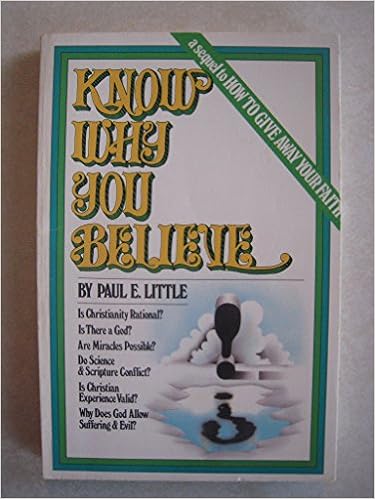
Book Review: Know Why You Believe by Paul E. Little

This review was originally posted on Goodreads.

Image Credit: Amazon. I actually read this 1968 version.

I read this book because it was on a "most influential books on evangelicals" list. I can see why it rightly was on that list. First, I'll briefly go over some positives; and then, some negatives.

"Are Miracles Possible?" was filled with tons of information that was new to me -- and the book is over 40 years old. This attests to either the author's creativity or to this reader's ignorance: I'd like to think it is the former.

The political scientists and analysts at the libertarian think-tank The Cato Institute often talk about the states (all 50 of them in the U.S.) as being "laboratories of democracy." Maryland has high taxes; Florida doesn't. New York has ridiculous rent control laws; other states don't. Through these legislative experiments we can see the effect on people. Some people move away from the states with high taxes, and so on.

In a passage Little briefly recalls atheist philosopher John Stuart Mill's view of divine justice via a quote from Hugh Evan Hopkins. If God were just, or if there was a thing as divine justice, then that justice would look like everyone getting their just reward according to their good deeds and bad deeds.

Little then says the most interesting thing to me in the book: "To see the logical consequences of Mill's "exact reward" concept of God in his dealings with man, we need only turn to Hinduism."

And by turning to Hinduism, and the lands effected by Hinduism, we are looking at "laboratories of theology." What are the results of this "exact reward" atheological experiment when the people believe that the god of the universe creates a system based on the thought of John Stuart Mill?

He continues: "The law of Karma says that all of the actions of life today are the result of the actions of a previous life. Blindness, poverty, hunger, physical deformity, outcastness, and other social agonies are all the outworking of punishment for evil deeds in a previous existence. It would follow that any attempt to alleviate such pain and misery would be an interference with the just ways of God. This concept is one reason why the Hindus did so little for so long for their unfortunates."

Then he presses in even more: "Some enlightened Hindus today are talking about and working toward social progress and change, but they have not yet reconciled this new concept with the clear, ancient doctrine of Karma, which is basic to Hindu thought and life."

In short, modern Hindus speak of reform.

But like with reforming Islam, to reform Hinduism its adherents would have to ignore their scripture.

At one point, in the lands given up this to religion, where one doesn't interfere with another person's karma, we saw people in poverty. Moreover, we also saw these countries taking a lot of time to catch up in wealth to Western countries. In contrast, in Christian U.S.A. we see all of the above social agonies being alleviated rapidly, because the Christian worldview allows for charity and entrepreneurship.

"Do Science and Scripture Conflict?" was golden, but it was not flawless. Little mentions certain presuppositions are necessary to science. This is good. However, the doesn't clamp down on the fact that only under the Christian worldview does science work.

Second, the chapter on archaeology and the Bible was a snooze. But I don't think I should be so crass as to say it was a worthless effort. There are people who attempt to discredit the Bible with archaeology, so it is only right that archaeology be covered.

To have written a book on apologetics 40+ years ago and still have insights that are fresh to a seasoned apologetics consumer (meaning I've watched a lot of debates and read a lot of articles on the subject) is an accomplishment.

Stylistically, this book was immensely quotable: I wanted to tweet every other paragraph. The book also simply ends. There is no final review of the cumulative case for Christianity or a concluding chapter.


I'd keep this book on the influential books list.

Wednesday, March 27, 2013

The Pro-Gay Marriage Reader - A Constitutional Perspective

The Constitutional Case for Same-Sex Marriage || UnitedLiberty.org

A strong argument that, while acknowledging that the libertarian notion that the best deal would be for the government to get out of the marriage business, also acknowledges the Jim Crow-like 2-tier marriage system is here and needs to be dealt with. Marriage for me, but not for thee, it argues, is not how things should be until the government gets completely out. Perhaps its most powerful argument, however, is that "[b]y outlawing same-sex marriage, the states are essentially forbidding religious institutions to marry whom they with."

The Moral and Constitutional Case for a Right to Gay Marriage || Cato.org

The Chairman of the libertarian-think tank the Cato Institute argues that "equal protection of the law" applies to homosexual/same-sex couples as well. Levy says that no compelling reason why the government sanctions marriage for heterosexuals and not for homosexuals has been given. Additionally, he argues that reasons to ban same-sex marriage - it would weaken the institution of marriage - isn't helped by that very ban, and offers legal suggestions to strengthen conservatives beloved institution.

The take-away from both articles:

The strongest case, it seems, for the pro-same-sex marriage crowd is to argue that banning gay marriage is a violation of the "equal protection of the law" granted in the 14th Amendment. Also, both writers are libertarians it seems they really wish - Levy uses the term "regrettably" - the government didn't get involved in marriage in the first place.

Bonus: Can We Really Get The Government Out of Marriage?

A piece giving a historical overview of the government's involvement in marriage, including property, taxes, and all sorts of benefits and protections, and acknowledges that "marriage licenses" are relatively new in human, or at least Western, history.

Bonus: When Did Laws Denying Same-Sex Couples Marriage Licenses Become Unconstitutional?

Another history lesson. This time, it answers when denying marriage licenses to gays became unconstitutional.

Tuesday, March 6, 2012

Ron Paul: Federal Government Fails at Running D.C. School System | CNSNews.com


(CNSNews.com) – Rep. Ron Paul (R-Texas) said Monday the federal government has proven ineffective at running an educational system, as evidenced by the D.C. school system, which spends $18,000 a student and is among the worst in the country. Paul is advocating getting rid of the Department of Education.

Ron Paul: Federal Government Fails at Running D.C. School System | CNSNews.com

Thursday, December 8, 2011

Ron Paul “Hardly” agrees with Herman Cain on Federal Reserve


Watch video here

Washington (GoinsReport.com) – When asked whether he agreed with GOP presidential candidate Herman Cain on his suggestion that Federal Reserve should go back to a single mandate focusing on price stability, GOP Presidential Candidate Ron Paul said that he “hardly” agrees.

Price stability refers to the concept that prices levels are constant enough that people won’t take into account price inflation when making decisions as a consumer – not that the value of the dollar will remain the same.

On numerous occasions this year, including at the CNN-Tea Party Republican debate in September and during a press conference with reporters at TeaCon 2011, Herman Cain said that he did not want to end the FED but return it to a single mandate where the central bank allegedly only focused on price stability.

During the CNN Tea Party debate in September, Cain said “For many, many decades the FED did its job when it was singularly focused on sound money.”

At TeaCon 2011 he said, “it [the FED] really needs to just focus on monetary price stability the way it did from 1913 all the way up to the year 2000. It got off track when the federal national debt hit 14 trillion dollars and when foreign countries cooled off on buying our debt.”

After reading the quotes from Herman Cain, GoinsReport.com asked Rep. Ron Paul (R-Texas) “Do you agree with that analysis and do you agree with his history?”

Paul said: “Well, hardly. He’s part of the Federal Reserve System and I want to get rid of it. So he’s trying to patch it up. No, I wouldn’t agree with it.”

The Texas congressman made his remarks Wednesday morning (Nov. 16) after the 29th Annual Monetary Policy conference in Washington, DC.

In his speech Paul was skeptical of the idea moving the FED’s dual mandate of using monetary policy to maximize employment and achieving price stability to a single mandate focusing on price stability alone.

“Since I don’t like the Fed, I’m not interested in worrying about what the mandate should be because they’re not going to do it anyway,” Paul said.

“They’re mandate is that they’re supposed to have full employment. They’re failing there. They’re supposed to have stable prices. They’re failing there. So why do we have any trust whatsoever in what they do,” he continued.

He added that “deep down in their hearts” their real goal is to accomplish the liquidation of debt with inflation.

“That’s not too hard to understand that if they can get 50 percent inflation rate in a year or two that takes our $15 trillion debt and cuts it in half,” Paul said.

In his speech, Paul said that he would not end the Federal Reserve in one day because it will “eventually shut itself down” when it destroys the currency. Rather he will work to break the FED’s monopoly on issuing currency by legalizing sound money including gold and silver and repealing legal tender laws.

“My idea is sort of a copy of what Hayek’s had talked about,” he said. “Why don’t we denationalize money, legalize competition, allow free markets to work, allow free market banking to work?”

He added that we should repeal taxes on gold and silver and even allow private mints to issue gold.

GoinsReport.com also asked Mark Calabria, a Cato Institute policy scholar in attendance, to give his opinion about Herman Cain’s statements about the Federal Reserve.

Calabria answered in two parts.

On Herman Cain’s timing of when the Federal Reserve abandoned a policy of price stability he said, “I would disagree somewhat in that particularly during the 60s and 70s we where seeing double-digit inflation. We certainly weren’t seeing a very good track record from the Federal Reserve.”

He added that because of the FED’s involvement in the Great Depression, which is still debated by economists today, “it would probably be generous to say that the FED has been a success even half the time it’s been around.”

In support of that, he highlighted the FED’s role in contributing to the real estate bubble and stock market bubble in the 1920s. He also said that problems the FED got into in 60s and 70s were a result of abandoning price stability as their primary goal.

Additionally, he said that he agreed with Cain’s comments that if the FED focused on price stability alone then they would do a better job.

Calabria said the FED got off track “long before” the U.S. national debt hit $14 trillion, a point it hit in late 2010, and when foreign countries slowed their purchases of U.S. debt. He added that when the debt started to skyrocket “they got even more off track.”

For him, the Phillips curve framework where “they believe that a little more inflation gets them a little less unemployment” took the FED off track. As an example, he cited the Federal Reserve cutting interests rates after the dot-com bubble and again after Sept.11 out of concern for reducing unemployment.

Calabria recently testified in October before the House Subcommittee on Domestic Monetary Policy and Technology Committee on Financial Services which Paul serves as chairman.

At the TeaCon 2011 press conference, Cain also said that the Federal Reserve System is not unconstitutional – a point in which Congressman Paul would sharply disagree with as well.

Rick Santorum has also said that he would, like Herman Cain, focus on bringing the Federal Reserve to a single mandate.

Friday, April 8, 2011

Michael Tanner on the What the Next President Should Be Like

In a recent opinion piece on the National Review (re-published by the Cato Institute), Michael Tanner commented on what the next president should be like. I completely agree:
Ryan's approach is a good start. But for the long term, it will require a 2012 presidential candidate capable of explaining the facts to an uninformed public and courageous enough to make the necessary cuts — even if the public thinks they hurt.
This is Going to Hurt

Monday, April 4, 2011

Video: Look at the Baby on the Left

By using the term "left" in the title, I almost made a double entendre. Anyway, watch the video to see some Clintonite nearly cry when Dan Mitchell of the Cato Institute clumps Bush and Obama together.

Tuesday, March 15, 2011

P.J. O'Rourke: Don't Vote It Just Encourages the Bastards

Ben Friedman on our Foreign Policy

Ben Friedman on our priorities:
As my colleague Ben Friedman puts it, we "defend allies that can defend themselves, fight in other people's civil wars in a vain effort to 'fix' their states and burn tax dollars to serve the hubristic notion that U.S. military hegemony is what keeps the world safe."

Read Rising Generation Rejects "Globocop" Role

Sunday, February 20, 2011

Chris Edwards Juxtaposes Wisconsin w/Egypt

I recently had the chance to interview Chris Edwards. Unfortunately, this is not it:
Chaos in government. Tens of thousands of angry protesters in the streets. Schools closed. Yes, Wisconsin looks a lot like Egypt this week. But while Arabs are fighting to end extraordinary overreach by government, Wisconsin union protesters are fighting to preserve it.
Read the rest of the column here.

VIdeo: Michael Tanner Discusses the FY2012 Budget

WCF Chapter One "Of Holy Scripture" Sunday School (Sept.-Oct. 2021)

Our text for Sunday School (also "The Confession of Faith and Catechisms") Biblical Theology Bites What is "Biblical Theology...