Showing posts with label Science. Show all posts

Thursday, December 31, 2015

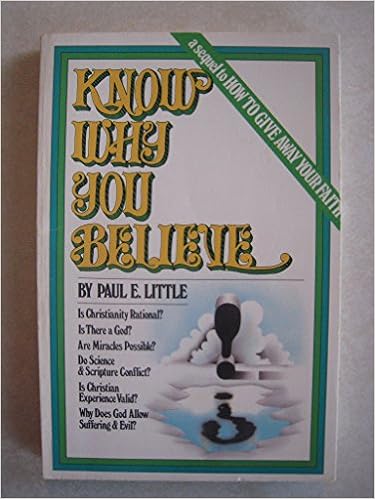
Book Review: Know Why You Believe by Paul E. Little

This review was originally posted on Goodreads.

Image Credit: Amazon. I actually read this 1968 version.

I read this book because it was on a "most influential books on evangelicals" list. I can see why it rightly was on that list. First, I'll briefly go over some positives; and then, some negatives.

"Are Miracles Possible?" was filled with tons of information that was new to me -- and the book is over 40 years old. This attests to either the author's creativity or to this reader's ignorance: I'd like to think it is the former.

The political scientists and analysts at the libertarian think-tank The Cato Institute often talk about the states (all 50 of them in the U.S.) as being "laboratories of democracy." Maryland has high taxes; Florida doesn't. New York has ridiculous rent control laws; other states don't. Through these legislative experiments we can see the effect on people. Some people move away from the states with high taxes, and so on.

In a passage Little briefly recalls atheist philosopher John Stuart Mill's view of divine justice via a quote from Hugh Evan Hopkins. If God were just, or if there was a thing as divine justice, then that justice would look like everyone getting their just reward according to their good deeds and bad deeds.

Little then says the most interesting thing to me in the book: "To see the logical consequences of Mill's "exact reward" concept of God in his dealings with man, we need only turn to Hinduism."

And by turning to Hinduism, and the lands effected by Hinduism, we are looking at "laboratories of theology." What are the results of this "exact reward" atheological experiment when the people believe that the god of the universe creates a system based on the thought of John Stuart Mill?

He continues: "The law of Karma says that all of the actions of life today are the result of the actions of a previous life. Blindness, poverty, hunger, physical deformity, outcastness, and other social agonies are all the outworking of punishment for evil deeds in a previous existence. It would follow that any attempt to alleviate such pain and misery would be an interference with the just ways of God. This concept is one reason why the Hindus did so little for so long for their unfortunates."

Then he presses in even more: "Some enlightened Hindus today are talking about and working toward social progress and change, but they have not yet reconciled this new concept with the clear, ancient doctrine of Karma, which is basic to Hindu thought and life."

In short, modern Hindus speak of reform.

But like with reforming Islam, to reform Hinduism its adherents would have to ignore their scripture.

At one point, in the lands given up this to religion, where one doesn't interfere with another person's karma, we saw people in poverty. Moreover, we also saw these countries taking a lot of time to catch up in wealth to Western countries. In contrast, in Christian U.S.A. we see all of the above social agonies being alleviated rapidly, because the Christian worldview allows for charity and entrepreneurship.

"Do Science and Scripture Conflict?" was golden, but it was not flawless. Little mentions certain presuppositions are necessary to science. This is good. However, the doesn't clamp down on the fact that only under the Christian worldview does science work.

Second, the chapter on archaeology and the Bible was a snooze. But I don't think I should be so crass as to say it was a worthless effort. There are people who attempt to discredit the Bible with archaeology, so it is only right that archaeology be covered.

To have written a book on apologetics 40+ years ago and still have insights that are fresh to a seasoned apologetics consumer (meaning I've watched a lot of debates and read a lot of articles on the subject) is an accomplishment.

Stylistically, this book was immensely quotable: I wanted to tweet every other paragraph. The book also simply ends. There is no final review of the cumulative case for Christianity or a concluding chapter.


I'd keep this book on the influential books list.

Tuesday, August 4, 2015

John Frame on The Nature of Science

From the article "Is Intelligent Design Science?" in Volume 17, Number 33, August 9 to August 15, 2015 of Reformed Perspectives Magazine:
Science is religious. A great many writers (Kuyper, Dooyeweerd, Clouser, Van Til, Polanyi, Kuhn, Hanson, Poythress) have made an impressive case that science is not religiously neutral. At the most obvious level, science presupposes many things that it cannot prove, but must take on faith: the uniformity of nature, the correspondence of thought with reality, the universality of physical laws, the values required for the honest pursuit of truth. Indeed, their ideas and methodology presuppose Christian theism, though not all of them are willing to admit it.
Despite the uncertainty of much science, there is also a sense in which science, like religion, imposes "orthodoxy" on its participants. As Kuhn indicates, bodies of research create communities of scientists, and if anyone wants to enter that community he must not deviate from the standard paradigms. Certainly something like this has happened among Neo-Darwinists. So there is a strong analogy between science and religion that has been overlooked in much of the discussion.
John Frame, "Is Intelligent Design Science?" 

Wednesday, March 25, 2015

Bill Nye on the Meaning of Life

Bill Nye was definitely a huge influence for me when I was younger. I'm glad I didn't learn what he believed about life through the television:


I'm insignificant. ... I am just another speck of sand. And the earth really in the cosmic scheme of things is another speck. And the sun an unremarkable star. ... And the galaxy is a speck. I'm a speck on a speck orbiting a speck among other specks among still other specks in the middle of specklessness. I suck. ~Bill Nye

Tuesday, February 17, 2015

Video: David Berlinski on Science, Philosophy, and Society


David Berlinski is the author of The Devil's Delusion: Atheism and its Scientific Pretensions. He's consistently good in so many different ways.

Monday, December 9, 2013

Bill Provine says evolution means no gods, no purpose, no life after death, etc

‘Let me summarize my views on what modern evolutionary biology tells us loud and clear … There are no gods, no purposes, no goal-directed forces of any kind. There is no life after death. When I die, I am absolutely certain that I am going to be dead. That’s the end for me. There is no ultimate foundation for ethics, no ultimate meaning to life, and no free will for humans, either.’ ~William Provine, 1994
While I somehow ran across this quote today from Creation.com (and I really don't know how I got to Creation.com, since I visit it only a few times a year, meaning 0-3; maybe I clicked on a link on a Youtube video I watched today), I actually heard Provine say this quote in his debate with Phillip E. Johnson many years ago. That's the only reason I'm quoting it; because it has sentimental value. It is otherwise pretty pedestrian, even if it is revealing. 

I watched that video back as an undergraduate; it is below.


But on the free will thing, agnostic physicist Michio Kaku would disagree.

Wednesday, April 7, 2010

Collegian Writings


So, I am also a writer for The Collegian, La Salle University's student-run newspaper. Please check out my published articles online (you may have to type 'Goins' into the search bar). So far, they've only posted 6 articles, but I've written more than that. I plan to expound on some of the ideas presented in the articles later in this blog.

1. La Salle's Lessons and Laissez-Faire
2. Shroud of Turin Mystifies but provides no certainty
3. Hyperinflation an Under-Reported Story
4. Walter Williams a notable city native
5. Miller Shows Faults on both sides
6. Aching for the truth on health reform

I also encourage you to read the other columnists in the Commentary section and beyond.

WCF Chapter One "Of Holy Scripture" Sunday School (Sept.-Oct. 2021)

Our text for Sunday School (also "The Confession of Faith and Catechisms") Biblical Theology Bites What is "Biblical Theology...