Showing posts with label Murray Rothbard. Show all posts

Monday, July 12, 2021

10 Free Books for Understanding the Economy Today

If you want to learn how we have gotten to where we are today, then you've landed at the right spot. 

These books were some of the first books I ever read on economics. 

They were preceded only by "The Alpha Strategy" (My Most Visited Post! Free Download! A great book for today in these inflationary times), the Politically Incorrect Guide to Capitalism, The Gold Wars (free download), Economics in One Lesson (free download), Meltdown, End the Fed, and Crash Proof 1.0.

I gotta be honest. I read all the way up to Modern Money Mechanics and didn't finish the rest of the list. But even half the books below and the books above will give you a working economic knowledge for life. 

Any citizen will be an economically literate citizen even if he or she reads only half of these books.

These economics books are free for downloading. Read them in this order.

Gary North, Inherit the Earth

Gary North, Honest Money

Murray Rothbard, What Has Government Done to Our Money?

Gary North, Mises on Money

Murray Rothbard, The Case Against the Fed

Murray Rothbard, The Mystery of Banking

Federal Reserve Bank of Chicago, Modern Money Mechanics

Gene Callahan, Economics for Real People

Robert P. Murphy, Lessons for the Young Economist

Murray Rothbard, Man, Economy, and State; Robert P. Murphy, Study Guide for Man, Economy, and State

Source: Ten Free Economics Books for Understanding What Is Going On Today | Specific Answers 

I hope you enjoy the books! 

Next up will be books that will help you become a functional Christian.

Monday, October 12, 2015

Libertarianism leads to anarchy

Libertarianism leads to anarchy. When I was a libertarian anarchist, a self-described "Christian Rothbardian," I thought that was a good thing.

Monday, July 28, 2014

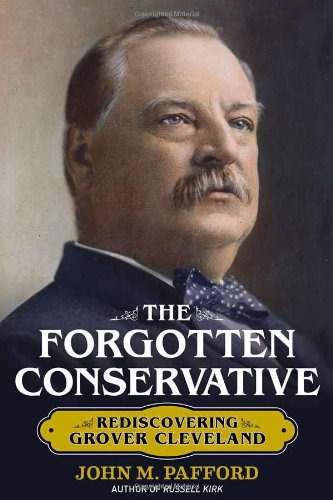
The Most Christian President in History -- and what his politics looked like

The last self-consciously Christian President was Presbyterian Grover Cleveland, who favored a gold standard, low taxes, free trade, and who vetoed more bills in two terms than any other President in history. (He had been known as the "veto mayor" of Buffalo, New York.) He served two terms, 1885-89 and 1893-97. From that point on, Christian politics slid down the road toward modern statism.
Gary North, Honest Money (p.133)


Those are his principles. Wikipedia has this nice summary:
Cleveland was the leader of the pro-business Bourbon Democrats who opposed high tariffs, Free Silver, inflation, imperialism, and subsidies to business, farmers, or veterans. His crusade for political reform and fiscal conservatism made him an icon for American conservatives of the era.[1] Cleveland won praise for his honesty, self-reliance, integrity, and commitment to the principles of classical liberalism.[2] He relentlessly fought political corruption, patronage and bossism. Indeed, as a reformer his prestige was so strong that the like-minded wing of the Republican Party, called "Mugwumps", largely bolted the GOP presidential ticket and swung to his support in the 1884 election.[3]
Libertarians tend to acknowledge Cleveland as one of the better U.S. president in American history when asked who is the best president. Mr. Libertarian himself, Murray Rothbard, the founder of modern Libertarian, thought that Martin Van Buren was the "best" (least bad) U.S. He briefly mentions Grover Cleveland and his major screw-up: the interstate commerce commission.


For more reading, check out the links below:


Sunday, July 14, 2013

A Conservative Icon Wrote This? F.A. Hayek on Compulsory Health Care

Sounding like Newt Gingrich and Barack Obama wrapped in one, the conservative--not libertarian--intellectual Friedrich Hayek pretty much defends the Affordable Care Act, President Barack Obama's signature legislative "achievement" in the realm of health.

Via GaryNorth.com:
"There is little doubt that the growth of health insurance is a desirable development. And perhaps there is also a case for making it compulsory since many who could thus provide for themselves might otherwise become a public charge. But there are strong arguments against a single scheme for state insurance; there seems to be an overwhelming case against a free health service for all." -- F. A. Hayek.
Hayek wrote this on page 298 of his magnum opus, The Constitution of Liberty (1960). We could put this another way.
This isn't about putting government in charge of your health insurance; it's about putting you in charge of your health insurance. Under the reforms we seek, if you like your doctor, you can keep your doctor. If you like your health care plan, you can keep your health care plan.
These words may sound familiar. They are from President Obama's 2009 speech calling on Congress to pass ObamaCare.
And this little nugget from North (not Hayek) here:
HAYEK WAS A CONSERVATIVE, NOT A LIBERTARIAN

Hayek was much closer to conservatives than to libertarians. He was much closer to Russell Kirk than he was to Murray Rothbard. Neither Kirk nor Hayek believed in economic law. They both rejected the idea on the same basis, namely, their commitment to some form of social evolution. Each of them would come down on the side of free-market institutions, for they did not trust the operations of state bureaucracies, but always on the basis of a pragmatic argument that society had chosen these free market institutions voluntarily. Then the question arises: "How can we stop the state from invading and capturing the institutions of society?" Or this: "How can we stop the politicizing of social institutions by the state?" Hayek had no philosophical answer, and neither did Kirk.
 F.A. Hayek: Obamacare's Defender || GaryNorth

Saturday, May 19, 2012

Murray Rothbard on the FED's Own Propaganda

"There is, however, one and only one aspect of the common legend that is indeed correct: that the overwhelmingly dominant cause of the virus of chronic price inflation is inflation, or expansion, of the supply of money. Just as an increase in the production or supply of cotton will cause that crop to be cheaper on the market; so will the creation of more money make its unit of money, each franc or dollar, cheaper and worth less in purchasing power of goods on the market."
Murray N. Rothbard, The Case Against the Fed

Saturday, May 5, 2012

Murray Rothbard on Public Schools

To the religious conservatives: Restoring public prayer won't be enough, says Murray Rothbard.
Restoring prayer, however, will scarcely at this date solve the grievous public school problem. Public schools are expensive and massive centers for cultural and ideological brainwashing, at which they are unfortunately far more effective than in teaching the 3R's or in keeping simple order within the schools. Any plan to begin dismantling the public school monstrosity is met with effective opposition by the teachers' and educators' unions. Truly radical change is needed to shift education from public to unregulated private schooling, religious and secular, as well as home-schooling parents.
Murray Rothbard, The Religious Right: Towards A Coalition, The Irrepressible Rothbard: The Rothbard-Rockwell Report Essays Of Murray N. Rothbard

Murray Rothbard on Establishing a religion

Rothbard on establishing a religion:
Establishing a religion has a specific meaning: paying for ministers and churches out of taxpayer funds. To ban even voluntary prayer from the public schools, or to ban the teaching of religion, is a pettifogging willful misconstruction of the text and of the intent of the framers, in order to replace our former Christian culture with a left-secular one. The banning of creches in front of local town halls demonstrates how far the secularists will go--indeed shows how totalitarian they are in their drive to ban religion from public institutions.
Murray Rothbard, The Religious Right: Toward A Coalition, The Irrepressible Rothbard: The Rothbard-Rockwell Report Essays of Murray N. Rothbard

Monday, November 14, 2011

Murray Rothbard's Typewriter -- by Gary North

Rothbard was a lucid writer. Few scholars have ever combined the paraphernalia of academia — footnotes galore — with the ability to write clearly. Rothbard added effective rhetoric; his writing was lively, which has never been common among economists. I once wrote that if the Nobel Prize in economics were awarded for clarity — as John Wayne aptly put it, "that'll be the day" — Rothbard should win it.
Gary North, Murray Rothbard's Typewriter

Monday, July 25, 2011

Rothbard on the National Debt (Again)

The government gets the money by tax-coercion; and the public creditors, far from being innocents, know full well that their proceeds will come out of that selfsame coercion. In short, public creditors are willing to hand over money to the government now in order to receive a share of tax loot in the future. This is the opposite of a free market, or a genuinely voluntary transaction. Both parties are immorally contracting to participate in the violation of the property rights of citizens in the future. Both parties, therefore, are making agreements about other people's property, and both deserve the back of our hand.
Murray Rothbard, Repudiating the National Debt (For the original post in 2010 click here)

The pesky neighbor and the debt ceiling - The Hill's Congress Blog

My emphasis added (in italics):
When you read the above example, your first reaction might have been to dismiss the neighbor's debt as illegitimate and in no way your responsibility or your problem. You would be right. No fair-minded legal system would hold you responsible for such a debt, and would instead cart your thieving neighbor off to jail. Yet Congress can impose liabilities on you, your children, and grandchildren without your consent, and even without your knowledge. This is another example of government holding itself above the law.
The pesky neighbor and the debt ceiling - The Hill's Congress Blog

Paul sounds a lot like Rothbard (my emphasis added again in italics):
The government gets the money by tax-coercion; and the public creditors, far from being innocents, know full well that their proceeds will come out of that selfsame coercion. In short, public creditors are willing to hand over money to the government now in order to receive a share of tax loot in the future. This is the opposite of a free market, or a genuinely voluntary transaction. Both parties are immorally contracting to participate in the violation of the property rights of citizens in the future. Both parties, therefore, are making agreements about other people's property, and both deserve the back of our hand.
Murray Rothbard, Repudiating the National Debt

Monday, June 20, 2011

The Chicago School versus the Austrian School - Robert P. Murphy - Mises Daily

The Austrians are oddballs among professional economists for their focus on methodological issues in the first place. Indeed, Mises's magnum opus, Human Action, devotes the entire second chapter (41 pages) to "The Epistemological Problems of the Sciences of Human Action." There was no such treatment in the last Freakonomics book.

Although most economists in the 20th century and our time would disagree strongly, Mises insisted that economic theory itself was an a priori discipline.

The Chicago School versus the Austrian School - Robert P. Murphy - Mises Daily

Monday, May 30, 2011

Rothbard on the Libertarian Attitude Toward War

Excerpted from War, Peace and the State:
The libertarian's basic attitude toward war must then be: It is legitimate to use violence against criminals in defense of one's rights of person and property; it is completely impermissible to violate the rights of other innocent people. War, then, is only proper when the exercise of violence is rigorously limited to the individual criminals. We may judge for ourselves how many wars or conflicts in history have met this criterion.
Murray Rothbard, A Libertarian Theory of War

Monday, April 18, 2011

Featured on The #Libertarian Daily...again


I just found out that I was featured on The #Libertarian Daily...a day late. So I couldn't get the screen capture that I wanted and I had to use the search engine to find what article was featured.

As you can see above, my post about Murray Rothbard on the Clinton Administration was posted.

Thanks JP_O. Follow him on Twitter @JP_O.

Sunday, April 17, 2011

Rothbard: If the Clinton Administration is for it...It should be Opposed

In an essay against NAFTA, Rothbard gives a general rule that may apply to the Obama administration as well:
Kill Nafta – and strike a blow directly in the gut of the Clinton administration. A good rule of thumb: other things being equal, if the Clinton administration is for it, whatever it is, it should be opposed on general principles. The more the Clinton administration fails, the more it withers and dies, the more American freedom and prosperity, the more the Old Republic, shall live.
Murray Rothbard, STOP NAFTA!

Saturday, March 19, 2011

Gary North on Rothbard's Devastating Criticisms

From the speech Murray Rothbard as Academic Role Model:
Murray, however, was more like Samson in the biblical motif. He wasn’t using the jawbone of an ass; he was using Human Action – intellectually speaking devastating anyone he challenged. Rothbard’s challenges—when you’re done reading a Rothbard critique of somebody, you almost feel sorry for the victim. I mean he will start at the kneecap—those go immediately. Then he starts working on the arms and coup de grâce is when the head goes off.

Now this is completely different from David Gordon’s materials. Of course, he does it with this unbelievable slicing stiletto that the guy doesn’t know he’s got three or four mortal wounds in him and then they find the body drained of blood 20 minutes after the review is finished. You don’t see the guy being hammered to death, you just see at the end “you know I think he’s dead.”

With Rothbard you knew he was dead. You knew he was finished halfway through the review, but you just stuck around to see how the cou de gras would go.

Tuesday, December 14, 2010

Murray Rothbard on Writing Clearly

"It is not enough, after all, to be clear and brief; one must also have a pretty good idea of what one is saying." Murray Rothbard, Boom! Crack! Crash!

WCF Chapter One "Of Holy Scripture" Sunday School (Sept.-Oct. 2021)

Our text for Sunday School (also "The Confession of Faith and Catechisms") Biblical Theology Bites What is "Biblical Theology...